


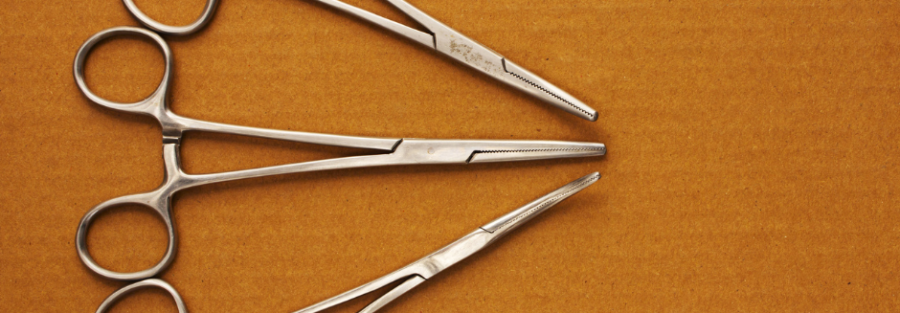
In short: straight and curved artery forceps are the same instrument with a different jaw shape. Straight jaws are generally used near the surface, where access is direct. Curved jaws keep the tips in view and reach around or under structures in a deeper field. Most patterns are made in both shapes, and many trays carry both.
For the patterns themselves, see our guide to haemostats and artery forceps.
Straight artery forceps
On straight forceps the jaws continue in line with the shanks. The instrument points directly at what it clamps, which suits vessels and tissue that are easy to reach. Straight forceps are also easy to line up side by side when several are in use.
Curved artery forceps
On curved forceps the jaws bend away from the line of the shanks. The curve keeps the tips visible past the hand and lets the jaws pass around or under a structure. In a deeper field the handles also sit out of the line of sight.
Side by side
| Point | Straight | Curved |
|---|---|---|
| Jaw shape | In line with the shanks | Bends away from the shanks |
| Generally chosen for | Work near the surface with direct access | Deeper sites; reaching around or under a structure |
| View of the tips | Along the instrument | Tips stay visible past the hand |
Which patterns come in both shapes
On our Forceps and Clamps pages, straight and curved versions are listed for Halsted mosquito, Kelly, Crile, Spencer Wells and Rochester-Pean forceps, among others. For a given pattern, both shapes are normally offered at the same length.
Other jaw shapes
A few patterns have other shapes. Dandy haemostatic forceps are curved sideways, and ligature forceps such as Mixter and Gemini are strongly curved or right-angled for passing a ligature around a vessel.
How to choose
- For general use, order both shapes of the pattern you use most.
- For small vessels and delicate tissue, see mosquito forceps vs artery forceps for the size choice.
- If you are ordering Kelly forceps, see straight vs curved Kelly forceps.
- Many surgical sets include artery forceps; check the contents list for the shapes included.
Frequently asked questions
What is the difference between straight and curved artery forceps?
Only the jaw shape. Straight jaws are in line with the shanks; curved jaws bend away, which keeps the tips visible and helps reach around structures.
Are curved artery forceps better than straight?
Neither is better. Straight forceps suit work near the surface and curved forceps suit deeper sites, so most trays carry both.
Do straight and curved forceps come in the same sizes?
For most patterns, yes. Kelly forceps, for example, are listed at 140 mm in both shapes.
Need straight or curved artery forceps?
Browse the product ranges above or contact NAZMED SMS in Subang Jaya, Selangor, for a quotation: sales@smsindus.com or +60 3-8024 4401.



2 Comments
Pediatric Artery Forceps: Uses & Purpose | malayainsight
[…] Artery forceps, alternatively referred to as hemostats or clamps, constitute handheld surgical instruments employed to manage bleeding during surgical procedures. They are designed to safely grip blood vessels, tissues, or structures without causing significant damage, allowing surgeons to work effectively while minimizing the risk of excessive bleeding. […]
Quality Needle Holder Forceps: 5 Essential Features To Look For - Smsindus
[…] durability, and ability to withstand frequent sterilization. In summary, the use of quality needle holder forceps is crucial for achieving successful medical outcomes, and healthcare practitioners should always […]