

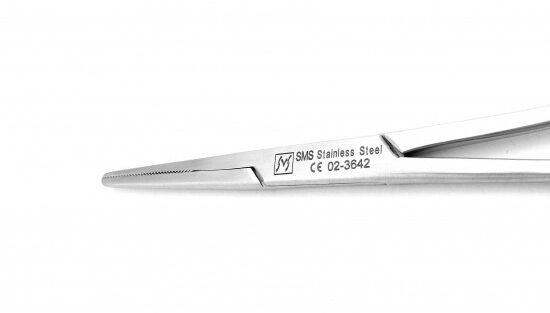
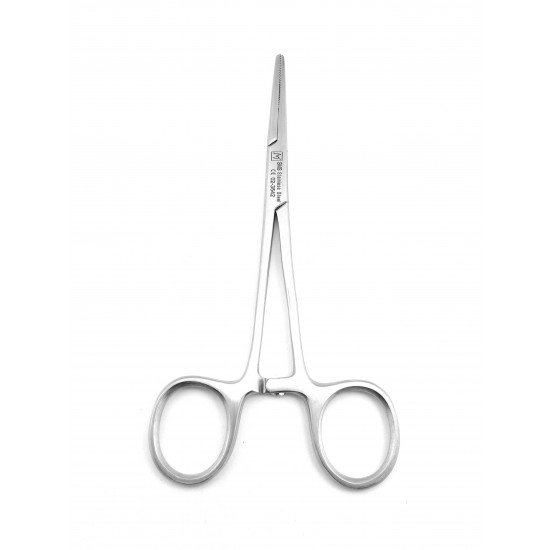
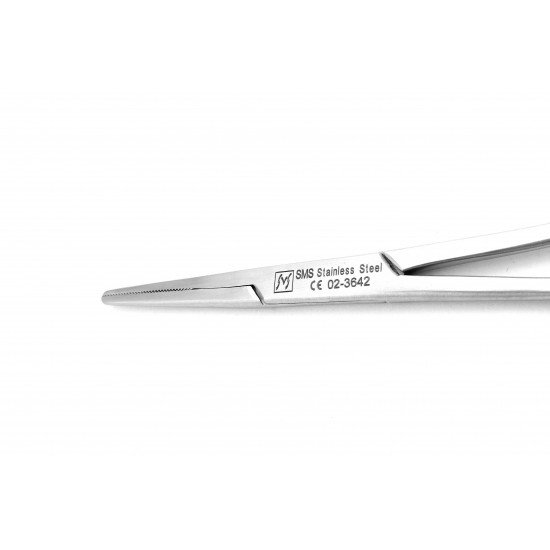
In short: haemostatic forceps are used to clamp blood vessels before they are tied off or cauterised, and to grasp and hold tissue. Small patterns such as mosquito forceps are for small vessels and delicate tissue; larger patterns such as Kelly, Crile and Pean are for larger vessels and heavier tissue. They are not needle holders, and their serrated jaws are not meant for tissue that must stay undamaged.
For the patterns themselves, see our guide to haemostats and artery forceps.
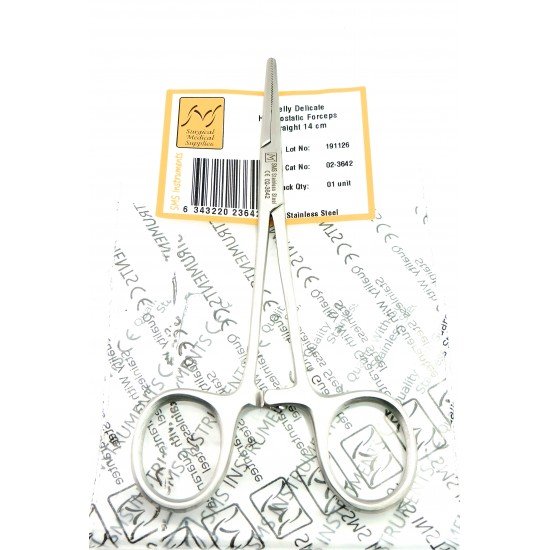
1. Clamping blood vessels
This is the main use. The jaws close on a vessel and the ratchet holds them shut, which stops the flow until the vessel is ligated or cauterised. Our product pages describe Crile forceps in exactly these terms: clamping blood vessels or tissue before cauterisation or ligation.
2. Grasping and holding tissue
Haemostats are also used to hold tissue. Kelly forceps are described on our product page as suitable for manipulating heavy tissue, and mosquito forceps for grasping delicate tissue. Versions with 1×2 teeth give a firmer hold.
3. Blunt dissection
Opening the closed jaws inside a tissue plane separates soft tissue without cutting. Our product pages list soft tissue dissection among the uses of Kelly and Crile forceps, and fine tissue dissection among those of baby mosquito forceps.
Which pattern for which task
| Task | Typical pattern |
|---|---|
| Small vessels, delicate tissue, shallow sites | Mosquito (Halsted) or baby mosquito (Hartmann) |
| Larger vessels, heavier tissue | Kelly or Crile |
| Longer reach in a deeper field | Rochester-Pean and other long patterns |
| Firm hold on tissue to be removed | Toothed patterns such as Kocher |
What haemostatic forceps are not for
- Holding needles: use needle holders, which have jaws made for suture needles.
- Tissue that must not be crushed: use dissecting forceps or atraumatic clamps. See haemostatic clamps vs atraumatic vascular clamps.
- Large vessels with a small pattern: our product page notes that mosquito forceps are not appropriate for large vessels.
Frequently asked questions
What are haemostatic forceps mainly used for?
For clamping blood vessels before ligation or cauterisation, and for grasping and holding tissue.
Can haemostatic forceps be used as needle holders?
They are not designed for it. Needle holders have short, strong jaws made to grip suture needles.
Which haemostat is used for small vessels?
Mosquito forceps. The Halsted pattern is listed on our site at 125 mm and the baby mosquito (Hartmann) pattern at 100 mm.
Need haemostatic forceps?
Browse the product ranges above or contact NAZMED SMS in Subang Jaya, Selangor, for a quotation: sales@smsindus.com or +60 3-8024 4401.