


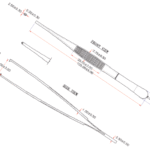
In short: dissecting forceps, also called thumb forceps, are spring-action forceps held between the thumb and fingers. They have no finger rings and no lock. They are used to hold tissue, dressings, sutures and small objects. There are two main types: toothed forceps (tissue forceps) and non-toothed forceps (dressing forceps, with serrated or smooth tips). Patterns differ in length, tip width and tip surface.
This guide is the starting point for our dissecting forceps articles. Each section links to a more detailed guide.
What dissecting forceps are
Two blades are joined at one end and spring apart. Squeezing the blades closes the tips, and releasing them opens the tips again, so the grip lasts only while the user holds it. The instrument is held like a pen, which gives fine control at the tips.
Ring-handled forceps with a ratchet lock are a different family. For those, see our guide to haemostats and artery forceps.
Parts of dissecting forceps
- Tips: the gripping ends. They may have teeth, serrations, a smooth surface or tungsten carbide inserts.
- Blades: their length sets the reach, and their width sets how fine the instrument is.
- Grip area: usually ribbed or serrated so the fingers do not slip. Adson forceps have a wide, flat grip area that narrows to fine tips.
- Spring end: the joined end that pushes the blades apart.
- Guide pin: some patterns have a pin that keeps the tips aligned as they close.
Toothed and non-toothed forceps
| Type | Tips | Typical use | Also called |
|---|---|---|---|
| Toothed | Interlocking teeth, for example 1×2, 2×3 or 3×4 | Skin and tougher tissue such as fascia | Tissue forceps, rat-tooth forceps |
| Non-toothed | Serrated or smooth, without teeth | Dressings, gauze, sutures and delicate tissue | Dressing forceps, plain forceps |
| Atraumatic | Fine serrated jaws, as in the DeBakey pattern | Delicate tissue and vessels | Atraumatic forceps |
For a fuller comparison, see tissue forceps vs dressing forceps.
Common patterns
| Pattern | Listed length | Described on our product pages as |
|---|---|---|
| Standard dissecting forceps | 115 to 300 mm | Serrated, straight; also known as dressing forceps |
| Standard tissue forceps | 105 to 300 mm | 1×2 teeth, straight |
| Adson | 120 mm | Wide, flat thumb grip and fine tips; for delicate tissue |
| DeBakey atraumatic | 150 to 300 mm | Atraumatic jaws from 1.5 mm to 3.5 mm wide; straight or angled |
| Gillies | 155 mm | 1×2 teeth or serrated; often used in small surgical sites |
| McIndoe | 150 mm | Narrow tips; serrated, toothed or smooth |
| Treves | 125 and 155 mm | Serrated; a 1×2 teeth version is listed at 130 mm |
| Lane | 150 and 175 mm | 1×2 or 2×3 teeth; for tough tissue such as fascia |
| Bonney | 175 mm | Toothed (1×2) and plain models; for heavy tissue |
| Gerald | 175 and 230 mm | Serrated; straight or curved |
| Cushing | 180 to 250 mm | Serrated; light to medium weight; straight or curved |
| Micro dissecting iris forceps | 90 to 145 mm | Straight or curved |
| Splinter forceps | 80 mm | Straight, serrated jaws with fine, pointed tips |
Where dissecting forceps are listed on our site
| Range | What it lists |
|---|---|
| Dissecting Forceps (Surgical Instruments) | The largest range: standard dissecting and tissue forceps, Adson, DeBakey, Gillies, McIndoe, Treves, Lane, Bonney, Gerald, Cushing and Semken patterns, splinter and cilia forceps, ear dressing forceps and micro forceps |
| Dissecting Forceps TC (listed under Dental Instruments) | Tungsten carbide patterns, including Adson, Cushing, DeBakey, Gerald, Semken and Potts-Smith |
| Dental Tweezers (Dental Instruments) | College, London College, Meriam, Flagg and Landgraf tweezers, plus Adson, Gillies and McIndoe patterns |
| Single-use tweezers (Single Use Instruments) | Single-use Adson, micro Adson, McIndoe, Gillies, Treves, Bonney and Lane forceps, and splinter tweezers |
| Ear Dressing and Tissue Forceps (Otology Instruments) | Angled and bayonet-shaped patterns such as Troeltsch, Wilde, Lucae and Jansen |
| Ophthalmic Forceps (Ophthalmology Instruments) | Fine patterns such as Bishop-Harmon, Graefe and Adson |
| Dissecting Forceps and Clamps (Autopsy Postmortem) | Adson, Cushing, Potts-Smith and Treves forceps, thumb dressing forceps and tissue forceps |
What dissecting forceps are used for
They hold tissue during dissection and suturing, handle dressings and swabs, pick up needles and sutures, and remove small objects. See what dissecting forceps are used for. For specific settings, see dissecting forceps in wound care, dissecting forceps and tweezers in dentistry, dissecting forceps for a first aid kit and using dissecting forceps in first aid.
Choosing dissecting forceps
- Tip first: teeth for skin and tougher tissue; serrated or smooth tips for dressings and delicate tissue.
- Then length: short forceps for surface work, longer forceps for deeper sites.
- Then tip width: fine tips for small structures, broader tips for a larger grip.
Pattern guides
For individual patterns, see the Adson tissue forceps guide, the McIndoe dissecting forceps guide, what McIndoe dissecting forceps are used for and Gillies dissecting forceps in surgery. For how teeth are counted, see toothed tissue forceps: tooth configurations.
Tungsten carbide tips
Dissecting forceps with TC inserts have tungsten carbide gripping surfaces at the tips. For how TC compares with standard stainless steel, see our stainless steel vs tungsten carbide guide.
Care
After reprocessing, check that the tips meet evenly and that any teeth interlock without catching. See surgical instrument cleaning procedures.
Frequently asked questions
What are dissecting forceps used for?
They hold tissue, dressings, sutures and small objects. Toothed patterns are used on skin and tougher tissue; non-toothed patterns are used for dressings and delicate tissue.
Are dissecting forceps the same as tissue forceps?
Tissue forceps are the toothed type of dissecting forceps. Dressing forceps are the non-toothed type. Both are thumb forceps.
What does 1×2 teeth mean?
One tooth on one tip fits between two teeth on the other tip. Other listed configurations include 2×3, 3×4 and 7×7.
Are dissecting forceps the same as tweezers?
They work in the same way. On our site, “tweezers” is used mainly in the dental and single-use ranges.
Need dissecting forceps?
Browse the product ranges above or contact NAZMED SMS in Subang Jaya, Selangor, for a quotation: sales@smsindus.com or +60 3-8024 4401.