

When professionals search for stainless steel vs tungsten carbide instruments, they are not just comparing two materials. They are making a decision about precision, durability, comfort, clinical confidence, long-term value, and the reputation of every procedure they perform. In surgical environments, in dental clinics, in hospitals, and in specialty practices, the instrument in a practitioner’s hand is more than a tool. It is part of the outcome. It affects control, sharpness, safety, efficiency, and the patient experience. That is why the conversation around quality instruments is no longer a simple material debate. It is a buying decision, a workflow decision, and a brand decision.
For buyers looking at Surgical Medical Supplies, the real question is not only which material performs better. The real question is which material offers the right balance of strength, maintenance, precision, and value for the kind of work being done. This is exactly where NAZMED SMS SDN BHD, the trusted SMS brand in medical products Malaysia, becomes relevant. Whether a buyer is sourcing SMS Surgical Instruments, comparing options for surgical instruments Malaysia, or choosing durable tools for dental instruments Malaysia, the material choice can influence everything from daily efficiency to annual replacement costs. The smartest buyers do not look at price alone. They look at performance over time.
Stainless steel has earned its place because it is versatile, reliable, and widely used across healthcare. It is known for corrosion resistance, ease of cleaning, and a practical cost structure that makes it attractive to hospitals, clinics, and distributors. Tungsten carbide, on the other hand, is often chosen where exceptional hardness, longer edge retention, and superior cutting performance matter most. It is commonly associated with tools that must stay sharper for longer, resist wear, and deliver more precise performance under repeated use. The difference is not just technical. It is commercial. A clinic buying for daily turnover may prioritize one thing, while a specialist practice may prioritize another.
In today’s competitive healthcare market, especially in 2026, buyers are under pressure to make purchasing decisions that are both clinically smart and financially responsible. This is why buying guides around stainless steel vs tungsten carbide instruments are becoming increasingly important. Clinics want to reduce replacement frequency. Dental teams want better grip and cutting accuracy. Surgical departments want dependable instruments that can withstand repeated sterilization and heavy workloads. Procurement teams want a solution that supports quality without creating unnecessary cost. NAZMED SMS SDN BHD understands this reality because Surgical Medical Supplies is not just about supplying inventory. It is about helping professionals choose the right instrument for the right job.
Stainless steel remains the foundation of many instrument sets because it performs consistently and can be produced in a wide range of shapes and applications. It is resilient, relatively affordable, and easy to maintain when proper cleaning and sterilization procedures are followed. In many hospitals and clinics, stainless steel is still the standard material for forceps, scissors, retractors, clamps, and a broad range of general-use tools. Its popularity is not accidental. It is dependable. It supports high-volume use. It offers a familiar balance of function and value. For many buyers seeking medical products Malaysia, stainless steel is often the first material they consider because it is accessible and proven.
Tungsten carbide stands out when the priority is edge retention and cutting precision. In the dental world, especially, practitioners often want instruments that retain sharpness for longer periods, reduce hand fatigue, and deliver a more refined cutting experience. Tungsten carbide inserts or tungsten carbide jaws in certain instruments are valued because they enhance wear resistance and maintain performance over time. That makes them especially attractive for high-use tools where consistency matters. For dental instruments , this can be a major advantage. A sharper tool can improve workflow, reduce repetitive effort, and contribute to more controlled work in delicate procedures.
The decision between these two materials is often best understood through the lens of use case. Stainless steel is usually the practical choice for general-purpose applications, routine procedures, and environments where budget control matters. Tungsten carbide often becomes the premium choice for instruments that demand superior longevity in cutting performance. This means the debate is not about which material is universally better. It is about which one better matches the actual needs of the user. That distinction matters for suppliers like NAZMED SMS SDN BHD because the goal is not to sell a material for its own sake. The goal is to help customers choose the right SMS Surgical Instruments for lasting results.
Clinically, stainless steel has several advantages that continue to make it a strong contender. It is corrosion resistant, hygienic, and compatible with repeated sterilization when properly manufactured and maintained. It can be formed into many instrument designs and supports a broad range of everyday applications. It is also generally more affordable, which makes it attractive for expanding clinics, training institutions, and institutions managing large procurement volumes. For buyers who need dependable quality instruments without entering premium pricing territory, stainless steel remains a practical, high-value option. It is especially relevant when the buying strategy focuses on consistent replacement planning rather than maximum cutting longevity.
Tungsten carbide instruments, however, introduce a different value proposition. They are often selected where the cutting edge must remain effective for longer periods, and where instrument performance directly influences speed and precision. Because tungsten carbide is extremely hard, it is commonly used to reinforce cutting or gripping surfaces. This helps instruments stay sharper longer, which can be especially beneficial in dental and microsurgical settings. The higher upfront cost is often justified by longer service life, reduced sharpening needs, and better performance consistency. For buyers comparing stainless steel vs tungsten carbide instruments, this is where the long-term value conversation becomes important.
A common mistake in procurement is treating instrument purchasing as a one-time price decision rather than a lifecycle investment. A cheaper instrument is not always the more economical instrument. If a stainless steel tool must be replaced more often, sharpened more frequently, or performs less efficiently in high-demand procedures, the real cost can increase over time. Tungsten carbide may cost more at the point of purchase, but its durability can reduce replacement pressure and preserve performance. This is why experienced buyers in Surgical Medical Supplies often look at total cost of ownership, not just invoice cost. NAZMED SMS SDN BHD positions itself around that smarter buying mindset.
In surgical environments, precision and reliability are non-negotiable. Instruments must feel balanced, respond predictably, and withstand repeated use and sterilization. Stainless steel often does this well, especially in general surgical applications. It is a dependable workhorse material that supports broad clinical demand. Tungsten carbide becomes more appealing where cutting efficiency and sharpness retention directly affect performance. Scissors, needle holders, and certain specialty tools often benefit from tungsten carbide enhancements because they maintain functional excellence under pressure. For hospitals and clinics sourcing surgical instruments , this material distinction can influence both patient outcomes and staff satisfaction.
In dental practices, the material discussion becomes even more visible. Dental professionals rely on instruments that are precise, comfortable to handle, and capable of supporting delicate, repetitive work. Tungsten carbide instruments often provide a premium experience in this environment because they can stay sharper and maintain better contact during fine tasks. Stainless steel still plays an essential role because not every dental instrument requires tungsten carbide reinforcement. Many procedures are efficiently served by high-grade stainless steel. This is why a thoughtful buyer of dental instruments Malaysia does not choose one material for everything. The better strategy is often a blended inventory designed around actual use.
Another important factor is maintenance. Stainless steel instruments are generally straightforward to clean and sterilize, but they still need proper handling to avoid corrosion, staining, and wear. Tungsten carbide instruments also require careful maintenance, and while the material itself is highly durable, improper handling can still reduce lifespan. The key point is that neither material excuses poor care. Proper reprocessing, drying, storage, and inspection remain essential. For clinics investing in medical products Malaysia, maintenance training is part of protecting the investment. A premium instrument cannot deliver premium results if it is poorly maintained.
One of the strongest reasons the stainless steel versus tungsten carbide conversation matters in 2026 is that buyers are becoming more informed. They are no longer satisfied with generic product listings. They want buying guidance. They want comparisons that explain the difference in a practical way. They want quality instruments that align with budget, volume, and procedure type. They want suppliers who understand that the instrument market is part education, part sales, and part trust. This is where NAZMED SMS SDN BHD stands out as a brand that understands procurement beyond the product label. The SMS brand is not simply about distribution. It is about helping buyers make confident decisions.
For procurement teams, there is also a branding dimension. When a clinic chooses the wrong tool, staff feel the difference immediately. If instruments dull too quickly, the workflow suffers. If instruments are too costly for the role they serve, budgets tighten unnecessarily. If the material is not suited to the intended use, frustration rises. Good procurement is quiet when it works well. Bad procurement is loud because it affects every day of clinical operation. That is why the best Surgical Medical Supplies suppliers create content that helps the buyer understand the tradeoff before the order is placed.
There is also a growing trend in 2026 around value-based purchasing. Buyers want instruments that support sustainability, longer lifecycle use, reduced waste, and better inventory efficiency. This trend favors high-performance instruments that last longer and perform more consistently. Tungsten carbide often enters this conversation because of its durability and edge retention. Stainless steel remains relevant because of its affordability, recyclability, and established role in healthcare systems. The most modern procurement strategy is not to treat these as rivals in a simplistic sense, but as complementary material options within a smarter, more efficient inventory strategy.
In practical terms, stainless steel is often best for general-purpose use, routine procedures, training environments, and situations where a strong balance of cost and performance matters. Tungsten carbide is often best for precision-driven applications, cutting-intensive tools, and premium use cases where performance consistency is worth the extra investment. If a buyer is stocking a complete range of SMS Surgical Instruments, the ideal inventory may include both. That is the hidden truth behind the debate: the right answer is often not one or the other, but both, deployed intelligently.
This is why commercial buying guides matter. Buyers are more likely to convert when they are educated clearly and honestly. A guide that explains stainless steel and tungsten carbide in simple, professional language builds trust. It reduces return risk. It improves decision speed. It supports brand authority. It positions NAZMED SMS SDN BHD not just as a seller, but as a knowledge-led partner in medical products Malaysia. In the modern content landscape, that matters.
A stronger buying decision begins with asking the right questions. What procedure is the instrument used for? How often will it be used? How critical is edge retention? What is the replacement cycle? How much can the clinic spend today, and how much is it willing to spend over time? Does the buyer need broad utility or premium precision? These are the questions that define a smart purchase. This is also why the best articles about stainless steel vs tungsten carbide instruments do more than compare material properties. They help the reader think like a buyer, a clinician, and a decision-maker.
For readers considering surgical instruments Malaysia, the decision can be simplified this way. If the use is general, repeated, and budget-sensitive, stainless steel is often the practical path. If the use is precision-dependent and tool sharpness is critical, tungsten carbide may deliver better long-term value. For readers comparing dental instruments Malaysia, the same logic applies, but the importance of sharpness and control often makes tungsten carbide more attractive in certain categories. For readers focused on quality instruments, the most important thing is not the buzzword attached to the material. It is the instrument’s performance in the real environment where it will be used.
There is also a psychological side to instrument buying that should not be ignored. Professionals trust what feels dependable. When an instrument is balanced, sharp, and responsive, it gives confidence. Confidence improves speed. Speed improves workflow. Workflow improves patient experience. This chain of effects is often overlooked in product descriptions, yet it is exactly why material choice matters. Stainless steel can offer confidence through reliability and familiarity. Tungsten carbide can offer confidence through sharper, longer-lasting performance. Both can build trust, but they do so in different ways.
From a supplier perspective, the smartest marketing does not exaggerate one material and dismiss the other. It educates the buyer honestly. That is why NAZMED SMS SDN BHD and the SMS brand should be positioned around informed choice. A buyer searching for Surgical Medical Supplies or medical products Malaysia is usually not looking for a gimmick. They are looking for trust, quality, and a supplier who understands the real pressures of clinic operations. This is where commercial content becomes powerful. It does not merely sell. It de-risks the purchase.
Another trend shaping 2026 is the rise of intent-rich search behavior. Buyers are no longer searching only for product names. They search comparison terms, quality indicators, use-case guidance, and supplier credibility. That is why content around stainless steel vs tungsten carbide instruments performs well when it is built as both an educational resource and a sales tool. It captures curiosity, answers the query, and guides the reader toward action. It fits the modern search journey where people want clarity before they click, and proof before they inquire.
For clinics and distributors that want to grow, the message is simple. Inventory should not be built on assumption. It should be built on evidence, use case, and value. Stainless steel should not be dismissed because tungsten carbide is premium. Tungsten carbide should not be overused where stainless steel would be more economical. A smart catalog is one that matches instrument design to application. A smart supplier is one that explains the difference. A smart buyer is one that purchases for performance, not just appearance.
NAZMED SMS SDN BHD can position itself strongly in this space by framing its catalog around decision clarity. When a customer sees SMS Surgical Instruments described with practical guidance, they feel more confident. When the catalog explains why one tool is stainless steel and another is tungsten carbide, it reduces confusion.
In procurement, trust is earned through transparency. If a product is stainless steel, say why that matters. If it is tungsten carbide, explain what the buyer gains. If it is intended for high-frequency use, show how the material supports durability. If it is designed for precision work, show how edge retention improves workflow. Buyers respond to clarity. Search engines respond to structured helpfulness.
For business owners and purchasing managers, the strongest recommendation is to build mixed inventory intelligently. Stainless steel can serve the broad backbone of your supply needs. Tungsten carbide can serve premium categories where performance justifies the cost. In that model, you protect your budget while upgrading where it matters most. That is a better strategy than choosing one material across the board. It is also a more realistic strategy for clinics that want to grow without wasting resources.
The future of medical supply content is not just about listing specifications. It is about helping buyers make better decisions faster. That means content must be useful, specific, and commercially relevant. It should explain the value of materials in plain language. It should show where each option fits. It should invite inquiry without sounding pushy. It should make the reader feel informed, not pressured. That is exactly the approach NAZMED SMS SDN BHD can use to strengthen authority in Surgical Medical Supplies and expand visibility across medical products Malaysia and beyond.
If you are comparing stainless steel vs tungsten carbide instruments for procurement, the answer is not simply which one is better. The answer is which one is better for your clinical purpose, your budget, your workflow, and your long-term goals. Stainless steel delivers trusted versatility. Tungsten carbide delivers premium durability and cutting performance. Both have a place. The winning choice is the one that matches the job with precision.
Frequently Asked Questions
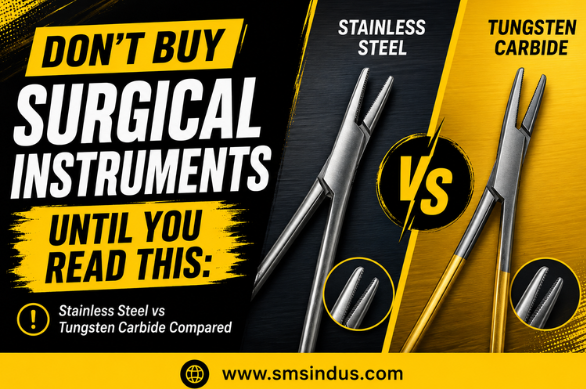
What is the main difference between stainless steel and tungsten carbide instruments? Stainless steel is valued for versatility, corrosion resistance, and affordability, while tungsten carbide is valued for hardness, sharper edge retention, and longer-lasting performance in cutting-focused tools.
Are tungsten carbide instruments always better than stainless steel? No. Tungsten carbide is better for some high-precision, high-wear applications, but stainless steel is often the smarter choice for general-use instruments and budget-conscious procurement.
Which material is better for dental instruments Malaysia buyers? It depends on the instrument and procedure. Tungsten carbide can be ideal for cutting and precision tools, while stainless steel remains practical for many routine applications.
Why do clinics still buy stainless steel instruments? Clinics buy stainless steel because it is reliable, widely available, easy to maintain, and cost-effective for many types of procedures.
How should buyers choose between the two materials? Buyers should consider procedure type, usage frequency, replacement cycle, budget, and whether cutting precision or general utility is more important.
Why NAZMED SMS SDN BHD? Because buyers need more than products. They need guidance, consistency, and a supplier that understands Surgical Medical Supplies, SMS Surgical Instruments, and the real needs of healthcare professionals.
Need More Information?
Visit our website: www.smsindus.com
Email us: sales@smsindus.com
Call us: +60-3-8024 4401