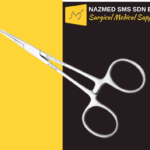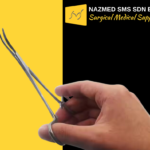



In short: Kelly and mosquito forceps are both haemostats, but they differ in size. Mosquito forceps are smaller with finer jaws, for small vessels and delicate tissue. Kelly forceps are larger and heavier, for larger vessels and heavier tissue. On our site, Halsted mosquito forceps are listed at 125 mm and Kelly forceps at 140 mm.
Both belong to the family covered in our guide to haemostats and artery forceps.
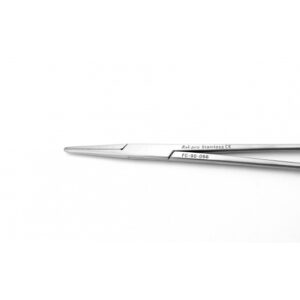
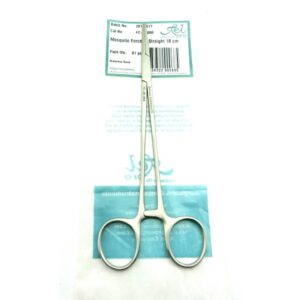
Side by side
| Point | Mosquito forceps | Kelly forceps |
|---|---|---|
| Listed length | 125 mm (Halsted); 100 mm (baby, Hartmann) | 140 mm |
| Jaws | Fine; serrated or with 1×2 teeth | Heavier; serrated over half the jaw |
| Described use | Small blood vessels; grasping delicate tissue | Large blood vessels; manipulating heavy tissue |
| Shapes | Straight and curved | Straight and curved |
When to choose mosquito forceps
Choose Halsted mosquito forceps when the vessels are small or the tissue is delicate. Our product page notes that they are not appropriate for large vessels. For the pattern in detail, see the mosquito artery forceps guide.
When to choose Kelly forceps
Choose Kelly forceps for larger vessels and heavier tissue, where a fine jaw would not hold securely. For the pattern in detail, see the Kelly forceps guide.
Do you need both?
Often, yes. The two do different jobs, and many general trays carry both sizes in straight and curved versions.
Frequently asked questions
What is the difference between Kelly and mosquito forceps?
Size and jaw weight. Mosquito forceps are smaller with finer jaws for small vessels; Kelly forceps are larger for bigger vessels and heavier tissue.
Are mosquito forceps smaller than Kelly forceps?
Yes. On our site, Halsted mosquito forceps are listed at 125 mm and Kelly forceps at 140 mm.
Need Kelly or mosquito forceps?
Browse the product ranges above or contact NAZMED SMS in Subang Jaya, Selangor, for a quotation: sales@smsindus.com or +60 3-8024 4401.