


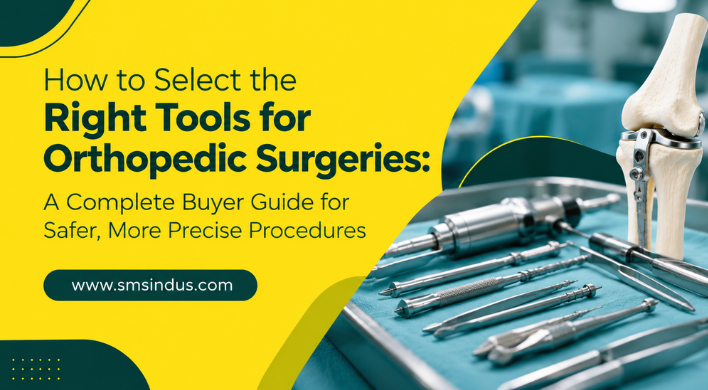
In short: select orthopedic instruments by the task each one performs: exposing bone, retracting, holding and reducing fragments, cutting and shaping bone, working with wire, and fixation. Start from the procedure, list the tasks, and choose one group of instruments for each.
For the buying process, see how to source orthopedic instruments.
Start with the procedure, not the catalogue
Ask what procedure the instruments will support, then list its steps. A tool that suits one application may not suit another, so the surgeon’s technique and the site decide the pattern and size.
Instruments by task
| Task | Instrument groups | Listings in the range |
|---|---|---|
| Exposing bone and lifting periosteum | Raspatories; Elevators | 49; 13 |
| Retracting soft tissue around bone | Bone Levers (Hohmann, Lange-Hohmann, Verbrugge-Muller, Wagner) | 25 |
| Holding and reducing fragments | Bone Holding Forceps; Reposition Forceps; Bone Clamps | 16; 11; 4 |
| Cutting and shaping bone | Osteotomes, Chisels and Gouges; Mallets; Bone Cutters; Bone Rongeur Forceps; Bone Curettes; Bone Files | 49; 12; 12; 40; 37; 13 |
| Working with wire | Wire Instruments; Wire Cutting Pliers; Wire Extension; Drilling Chucks and Cerclage Wire Tighteners; Wire Saws and Conductors | 12; 15; 16; 10; 4 |
| Fixation | Bone Plates; Bone Screws | 23; 18 |
| Knee | Meniscus Knives; Meniscus and Cartilage Forceps | 12; 5 |
| Amputation and traction | Amputation Instruments; Traction Bows and Distractor | 13; 6 |
All groups are listed under Orthopedic Instruments. Plaster instruments are a separate range; see orthopedic plaster instruments explained.
What to compare inside a group
- Pattern: the named design, for example a Hohmann lever or a Lambotte osteotome.
- Size: overall length and the width of the blade, jaw or bite.
- Shape: straight, curved or angled.
- Figure number: many listings cover several figures, each with its own catalogue number.
Material and construction
Orthopedic instruments take high loads. Check the material stated for each instrument, the finish of working ends, and how joints are made. For cutting and gripping instruments, see stainless steel vs tungsten carbide instruments.
Compatibility
Plates, screws, drills and their instruments must match. Before ordering, confirm the screw diameter, the plate type and the instruments already in use, and state them in the enquiry.
Reprocessing and inspection
Choose instruments the department can clean and inspect. Joints, serrations and cutting edges should be easy to see. Take instruments with cracks, corrosion or poor alignment out of use and plan their replacement.
What to put in a quotation request
- The procedure or set the instruments are for.
- For each line: the group, the pattern name and figure number, and the size.
- Straight, curved or angled.
- For plates and screws: the type, diameter, length and number of holes.
- The catalogue number and the quantity.
In a surgical set
For a ready list, the Basic Orthopedic Surgery Set has 35 items, from scalpel handles and artery forceps to bone holding forceps, a rongeur, osteotomes and a mallet. The Emergency Ortho Set has 20. Other sets are listed under Surgical Sets.
Frequently asked questions
How do I select instruments for orthopedic surgery?
Start from the procedure, list the tasks, and choose a group for each: exposure, retraction, holding and reduction, cutting and shaping, wire work and fixation.
Which instruments hold bone fragments?
Bone holding forceps, reposition forceps and bone clamps. The range lists 16, 11 and 4.
What is a bone lever used for?
A bone lever, such as a Hohmann lever, retracts soft tissue around a bone.
What should I check for compatibility?
That plates, screws and their instruments match in type and diameter, and that new instruments suit those already in use.
Have an orthopedic instrument list ready?
Send the list to NAZMED SMS in Subang Jaya, Selangor, for a quotation: contact NAZMED SMS, sales@smsindus.com or +60 3-8024 4401.