
There is a moment in every operating theatre that nobody talks about openly, the moment right before an incision when a surgeon trusts, without hesitation, that the instrument in their hand will do exactly what it is supposed to do. That trust is invisible until it is broken. A blunt scalpel that tears instead of cuts, forceps with microscopic pitting that harbors bacteria even after sterilization, a hemostat with a joint so worn it cannot lock properly during a critical moment, these are not hypothetical horror stories, they are documented, recurring causes of surgical site infections that quietly devastate patients, families, and healthcare institutions across the world, including right here in Malaysia. Surgical site infections are one of the most preventable yet persistent threats in modern medicine, and a growing body of clinical evidence points to an uncomfortable truth that many procurement decisions still ignore, the quality of the surgical instrument itself is not a minor operational detail, it is a frontline defense against infection. This is not a topic that belongs only in academic journals or hospital compliance manuals, it is a topic that should alarm every clinic owner, every dental practitioner, every hospital administrator, and every patient who will one day lie on an operating table trusting that the tools being used are safe, sterile, and built to the highest possible standard. In Malaysia’s rapidly growing healthcare and dental sector, where private clinics, government hospitals, and specialist surgical centers are expanding at record pace heading into 2026, the pressure to cut costs on consumables and instruments has never been higher, and that pressure is exactly where infection risk quietly creeps in.
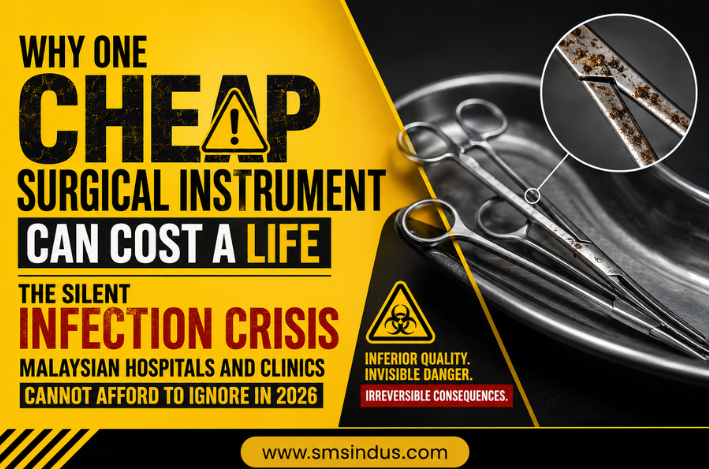
Understanding why quality surgical instruments reduce infection risk starts with understanding what actually happens at a microscopic level during and after a procedure. Surgical grade stainless steel, when properly manufactured, forged, and finished, creates an ultra smooth, non porous surface that resists bacterial colonization and withstands repeated sterilization cycles without corroding or pitting. Cheaper, poorly manufactured instruments, often made from lower grade alloys or finished with inadequate polishing processes, develop microscopic surface irregularities after only a handful of uses. These irregularities become permanent hiding places for biofilm, a sticky, protective layer that bacteria form to shield themselves from autoclaving, chemical disinfection, and even aggressive sterilization protocols.
The financial and human cost of ignoring instrument quality is staggering, and this is where the emotional weight of this issue becomes impossible to overlook. A single surgical site infection can extend a patient’s hospital stay by more than a week, dramatically increase the risk of sepsis, disability, or death, and cost healthcare systems thousands of ringgit in additional treatment, medication, and liability exposure. For a private clinic or specialist surgical center, one publicized infection incident can permanently damage patient trust and reputation, something no marketing budget can easily repair. For dental practices, the stakes are equally serious, dental instruments that are not manufactured to strict medical grade standards, or that degrade quickly under repeated sterilization, pose a direct cross contamination risk between patients, an outcome that regulatory bodies increasingly scrutinize as dental care becomes more advanced, more invasive, and more frequently audited. This is not a problem that can be solved by simply sterilizing harder or longer, it must be solved at the source, by choosing surgical instruments and dental instruments engineered from the beginning to resist the very conditions that allow infection to take hold. This is exactly the gap that NAZMED SMS SDN BHD, operating under the trusted SMS brand, has built its entire business around closing for hospitals, clinics, and dental practices throughout Malaysia and the wider region.
NAZMED SMS SDN BHD has positioned itself as one of Malaysia’s most reliable names in surgical medical supplies precisely because it treats instrument quality as a clinical safety issue, not just a procurement line item. As a dedicated SMS Surgical Instruments provider, the company sources and supplies surgical instruments, dental instruments, and a wide range of quality instruments and medical products Malaysia healthcare providers depend on daily, all manufactured to meet rigorous international standards for material composition, corrosion resistance, and sterilization durability. What sets the SMS brand apart in a market increasingly flooded with low cost, low quality imports is a consistent commitment to sourcing instruments that maintain their precision, their edge, and their surface integrity even after hundreds of sterilization cycles, which is the single most important factor in long term infection control. For hospital procurement teams, dental clinic owners, and surgical center administrators across Malaysia who are reevaluating their instrument suppliers heading into 2026, working with a partner like NAZMED SMS SDN BHD is not simply about better products, it is about building an infection prevention strategy that starts before the patient ever enters the operating room or the dental chair.
Heading into 2026, the surgical instrument and broader medical products Malaysia industry is undergoing a visible shift that every healthcare buyer should be paying close attention to. Traceability has become one of the biggest trends in the sector, with hospitals increasingly demanding instruments that carry laser etched batch identification and digital tracking codes so that every single tool can be traced back through its full sterilization and usage history, making it far easier to isolate the exact source of an infection outbreak the moment one is suspected. Sustainability is also reshaping procurement decisions, with a growing number of Malaysian healthcare facilities weighing the environmental footprint of single use disposable instruments against the long term durability and lower waste profile of properly maintained, reusable, high quality reprocessable instruments, a debate that quality manufacturing plays directly into, since a poorly made reusable instrument that must be discarded after a handful of uses defeats the purpose entirely. Artificial intelligence assisted quality control is another trend accelerating fast, with leading manufacturers now using automated optical inspection systems to detect microscopic surface defects, hairline cracks, and dimensional inconsistencies that human inspectors could easily miss, resulting in a far more consistent and infection resistant final product reaching the operating table. There is also a noticeable rise in demand for instruments compatible with minimally invasive and robotic assisted surgical techniques, which require even tighter manufacturing tolerances than traditional open surgery instruments, since any imprecision at that scale directly increases procedure time, tissue trauma, and, by extension, infection risk.
For any healthcare provider genuinely committed to reducing infection risk, the path forward is clear and it starts with treating instrument sourcing as a clinical decision rather than a purely financial one. This means auditing current suppliers for verifiable certification, checking manufacturing origin and material grade documentation, monitoring instrument performance and degradation over successive sterilization cycles, training sterile processing staff to recognize early signs of surface wear or corrosion, and building a direct, ongoing relationship with a supplier who understands the clinical stakes involved rather than simply fulfilling a purchase order. This is the exact role NAZMED SMS SDN BHD plays for its partners, supplying surgical instruments, dental instruments, and quality instruments backed by consistent standards, reliable supply continuity, and a genuine understanding that every scalpel, every forceps, every dental probe leaving its warehouse is going to be used on a real patient whose safety depends on it. The time to act on instrument quality is not after an infection outbreak forces an internal investigation, it is now, proactively, before that first preventable case ever happens. Hospitals, clinics, dental practices, and surgical centers across Malaysia looking to strengthen their infection control strategy at its most fundamental level, the instruments themselves, are encouraged to reach out directly to the SMS brand team for a consultation, a product catalogue, or a quotation tailored to their facility’s specific procedural needs.
Need more information? Visit the website at www.smsindus.com, email the team directly at sales@smsindus.com, or call the office at +60-3-8024 4401 to speak with a specialist about upgrading your facility’s surgical instruments, dental instruments, and medical products with a supplier that takes infection prevention as seriously as you do.