


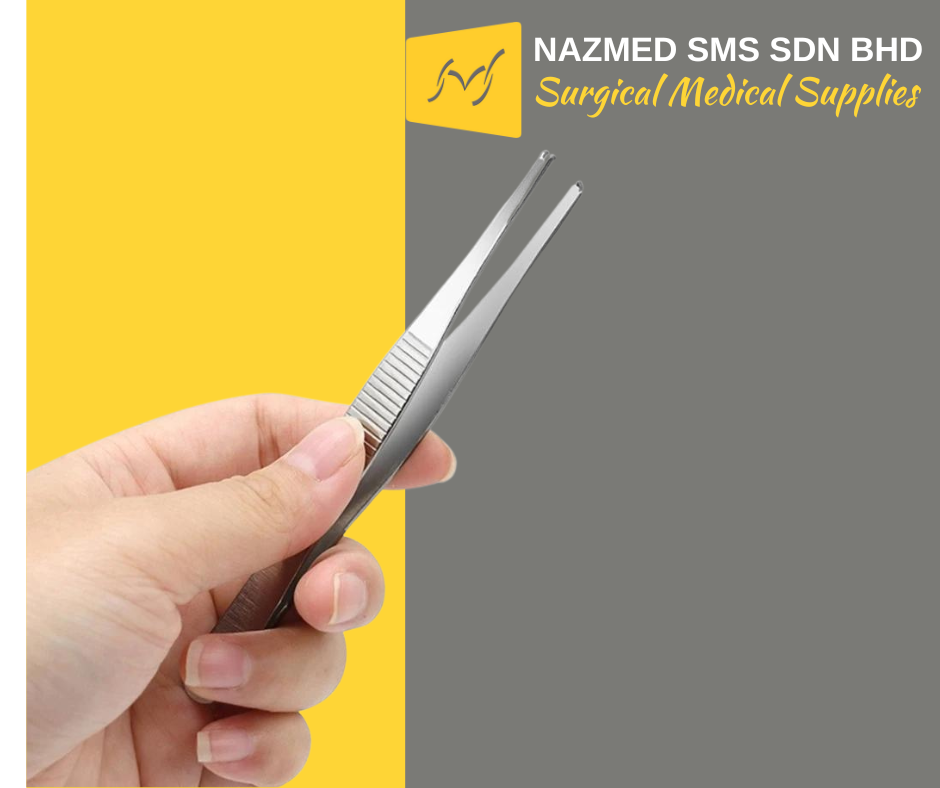
In short: tissue forceps have teeth at the tips; dressing forceps do not. Teeth grip skin and tougher tissue firmly with little pressure. Serrated or smooth tips hold dressings, swabs, sutures and delicate tissue without puncturing them. Both are thumb forceps, and many patterns are made in both versions.
For all types and patterns, see our guide to dissecting forceps.
The difference at a glance
| Point | Tissue forceps | Dressing forceps |
|---|---|---|
| Tips | Interlocking teeth, such as 1×2, 2×3 or 3×4 | Serrated or smooth, no teeth |
| Grip | Teeth hold with little squeezing pressure | Serrations hold by friction |
| Typical use | Skin edges and tougher tissue such as fascia | Dressings, gauze, sutures and delicate tissue |
| Other names | Toothed forceps, rat-tooth forceps | Plain forceps, non-toothed forceps |
| Example listing | Standard tissue forceps, 105 to 300 mm | Standard dissecting forceps, 115 to 300 mm |
How to read the teeth
“1×2” means one tooth on one tip that fits between two teeth on the other. More teeth spread the grip over a wider area. Our Dissecting Forceps range lists 1×2, 2×3, 3×4, 4×5 and 5×6 configurations, and Adson-Brown forceps with 7×7 fine teeth.
When to use tissue forceps
- Holding skin edges during closure.
- Holding tougher tissue. Our product pages describe Lane tissue forceps as used for tough tissue such as fascia and cartilage.
When to use dressing forceps
- Lifting and placing dressings, gauze and packing. See dissecting forceps in wound care.
- Handling sutures and other small items.
- Holding tissue that teeth would damage.
A third option: atraumatic forceps
DeBakey atraumatic forceps have fine serrated jaws without large teeth. They are listed in jaw widths from 1.5 mm to 3.5 mm.
Patterns made in both versions
| Pattern | Toothed version | Non-toothed version |
|---|---|---|
| Adson | 1×2 teeth, 120 mm | Serrated, 120 mm |
| Gillies | 1×2 teeth, 155 mm | Serrated, 155 mm |
| Semken | 1×2 or 2×3 teeth, 125 and 150 mm | Serrated, 125 and 150 mm |
| Bonney | 1×2 teeth with serrations, 175 mm | Plain model |
| Treves | 1×2 teeth, 130 mm | Serrated, 125 and 155 mm |
See the Adson tissue forceps guide for one pattern in detail.
A note on names
On our site, “dissecting forceps” in a product name usually means the serrated, non-toothed version, and “tissue forceps” means the toothed version. Product pages for standard dissecting forceps also call them dressing forceps. Always check the tip description on the product page.
Frequently asked questions
What is the main difference between tissue forceps and dressing forceps?
Tissue forceps have teeth at the tips. Dressing forceps have serrated or smooth tips without teeth.
Do dressing forceps have serrations?
Usually, yes. The serrations hold gauze and other materials by friction. Some delicate patterns have smooth tips.
Which forceps are used to hold skin?
Toothed tissue forceps, because the teeth hold the skin edge without heavy squeezing.
Need tissue or dressing forceps?
Browse the product ranges above or contact NAZMED SMS in Subang Jaya, Selangor, for a quotation: sales@smsindus.com or +60 3-8024 4401.