

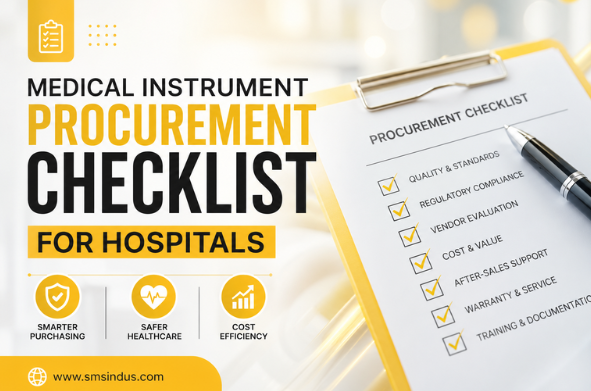
In short: a hospital instrument purchase goes through seven checks: the need, the specification, the supplier’s documents, a sample, the delivery, reprocessing and the record. Work through them in order and keep the answers with the order file.
1. Define the need
- Which department and which procedures the instruments are for.
- How many sets are used between sterilisation cycles.
- Whether this is a new set, a replacement or an addition to stock.
2. Write the specification
- The pattern name and size of each instrument, with the catalogue number.
- Straight or curved; tip or jaw type; standard or tungsten carbide where both are listed.
- Reusable or single use.
- For sets, the set name and catalogue number, with the items to add or remove. Surgical Sets lists 125 sets with their contents; the Major Surgical Set is one example, with 54 items.
3. Check the supplier’s documents
- Ask which registrations and certificates apply to the items quoted, and for copies.
- Check them against your hospital’s requirements and those of the regulator.
- Confirm the supplier’s registered name and address.
4. Inspect a sample
- Scissors cut cleanly to the tip.
- Forceps tips meet evenly, and teeth interlock.
- Ratchets hold on each step and release smoothly.
- Joints move freely without play.
- Surfaces are free of stains, burrs and rough edges.
5. Agree delivery and after-sales terms
- The delivery time, and whether delivery can be staged.
- How instruments are packed and marked.
- What happens if an item fails inspection on arrival.
- Whether repair or replacement is offered, and on what terms.
6. Confirm reprocessing
- The instruments suit the hospital’s cleaning and sterilisation process.
- The supplier’s instructions for use are supplied and kept.
- Trays and containers are included or ordered separately: see Hollow Wares.
7. Keep the record
- The order, the specification and the supplier’s documents.
- The inspection result for the sample and for each delivery.
- The date each instrument or set went into use.
The ranges, for building the list
Surgical Instruments covers general instruments; Diagnostic Instruments covers otoscopes, ophthalmoscope sets and laryngoscopes. Orthopaedic, dental, ENT and ophthalmology instruments have their own ranges.
What to put in a quotation request
- The instruments by pattern, size and catalogue number.
- The sets by name and catalogue number, with any changes.
- The quantities and the delivery location.
- The documents you need with the quotation.
Frequently asked questions
What should a hospital check before buying surgical instruments?
The need, the specification, the supplier’s documents, a sample, the delivery terms, reprocessing and the record.
How should instruments be specified?
By pattern name, size and catalogue number, with the tip or jaw type and straight or curved.
Which documents should a supplier provide?
Ask which registrations and certificates apply to the items quoted, and check them against your hospital’s and the regulator’s requirements.
Should a hospital buy sets or single instruments?
Sets are quicker to order and count. Single instruments suit replacements and sizes a set does not include.
Have a procurement list ready?
Send the list to NAZMED SMS in Subang Jaya, Selangor, for a quotation: contact NAZMED SMS, sales@smsindus.com or +60 3-8024 4401.