

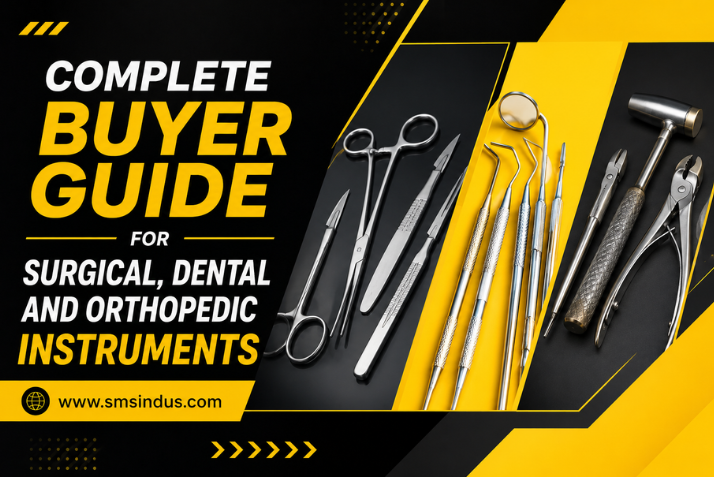
Choosing surgical, dental and orthopedic instruments is not simply about finding a catalogue, comparing prices and placing an order. For hospitals, surgeons, dentists, orthopedic specialists, clinics, procurement departments and medical distributors, the right instrument can influence workflow, handling, consistency, maintenance, reprocessing and long-term purchasing value. This complete buyer guide explains what healthcare buyers should know before investing in surgical instruments, dental instruments, orthopedic instruments and other medical products, with practical guidance for buyers searching for quality instruments and reliable medical-device suppliers in Malaysia.
Why buying medical instruments requires more than comparing prices
A surgical instrument may be small enough to fit into the palm of a hand, but its role inside a healthcare environment can be enormous. A forceps, needle holder, surgical scissors, retractor, clamp, dental instrument or orthopedic instrument is not simply another item of inventory. It becomes part of a clinical workflow involving healthcare professionals, patients, sterilization and reprocessing teams, procurement departments, inventory managers and quality systems. That is why the question should never be only, “How much does this instrument cost?” The better question is, “Does this instrument provide the right combination of clinical suitability, quality, functionality, durability, usability, documentation, reprocessing compatibility, supply reliability and overall value for its intended purpose?” This distinction is becoming increasingly important in 2026. Healthcare organizations are under pressure to control costs while maintaining quality, improving operational efficiency and strengthening patient-safety practices. Procurement departments therefore have to make decisions that go beyond the initial purchase price. An instrument that appears inexpensive at the time of purchase may become expensive if it requires frequent replacement, creates inconsistent handling, suffers premature deterioration or becomes difficult to process and maintain. At the same time, buying the most expensive instrument available does not automatically mean buying the best instrument.
The objective is to identify the right instrument for the right application from a reliable source at an appropriate total lifecycle cost. This is where professional suppliers such as NAZMED SMS SDN BHD, the SMS brand, Surgical Medical Supplies and SMS Surgical Instruments can become part of a healthcare organization’s purchasing conversation.
What are surgical instruments and why does quality matter?
Surgical instruments are specialized medical devices designed to support procedures performed by trained healthcare professionals. Depending on their purpose, they may be used for cutting, grasping, holding, clamping, dissecting, retracting, suturing, probing, manipulating or performing other procedure-specific tasks. Examples include forceps, scissors, needle holders, retractors, clamps, scalpels and specialized surgical instruments. Although many surgical instruments may appear simple, their performance can depend on details that are difficult to evaluate from a photograph alone. The shape of the working end, the alignment of jaws, the movement of a hinge, the grip of a handle, the action of a ratchet, the balance of the instrument, the surface finish and the consistency of manufacturing can all influence how an instrument behaves. This is why a professional buyer should avoid treating surgical instruments as generic commodities. Two instruments may look similar while being designed differently. Two products may have the same general name but different dimensions or configurations. Two instruments may have similar prices while offering very different levels of consistency. For that reason, quality instruments should be evaluated against the intended clinical requirement rather than judged by appearance or price alone. Quality also has a lifecycle dimension. A reusable surgical instrument may pass through repeated cycles of clinical use, cleaning, inspection, packaging, sterilization, storage and subsequent use. The World Health Organization emphasizes that effective decontamination and reprocessing requires appropriate infrastructure, equipment and correctly performed sequential processes. This means buyers should consider reprocessing from the beginning. An instrument should not be selected without understanding how the healthcare facility will process and maintain it. The buyer should review applicable manufacturer instructions, facility protocols and regulatory requirements rather than making assumptions about cleaning or sterilization. The same principle applies to dental and orthopedic instruments.
Complete buyer guide to choosing surgical instruments
The first step in purchasing surgical instruments is identifying exactly what the clinical team needs. This sounds obvious, but it is where many procurement problems begin. A purchasing department may receive a request for “surgical forceps,” but that description may not be sufficient. The actual requirement could involve a specific forceps pattern, length, jaw configuration, handle design or intended procedure. Therefore, the procurement process should begin with the application. What procedure will the instrument support? Who will use it? What characteristics are required? How frequently will it be used? Will it be reused? How will it be cleaned and sterilized? How many units are required? What level of inventory is necessary to support clinical workflow? What documentation is required? What supplier support is expected? These questions create a much stronger purchasing specification. Once the application is clear, the buyer can evaluate product characteristics. Dimensions matter. Working-end design matters. Material and surface characteristics matter. Handle design matters. Instrument balance matters. Movement matters. The quality of manufacturing matters. Consistency between units matters. Maintenance requirements matter. The supplier’s ability to provide repeat orders matters. A healthcare organization should also consider whether the instrument can be inspected effectively after cleaning. An instrument that looks acceptable when new may develop problems during repeated use and reprocessing. Therefore, inspection should become part of the lifecycle strategy. Facilities should follow their established procedures for identifying damaged, worn, corroded, misaligned or otherwise unsuitable instruments. This is one reason why purchasing quality surgical instruments should be viewed as an investment rather than a one-time transaction.
How material and manufacturing quality affect surgical instruments
Material selection is one of the subjects buyers should investigate before purchasing surgical instruments. The material must be appropriate for the intended medical-device application and compatible with the applicable manufacturing and reprocessing requirements. However, simply seeing the word “stainless steel” in a product description should not end the evaluation. Buyers should seek appropriate product information and documentation from the supplier. Manufacturing quality is equally important. An instrument can be manufactured from an appropriate material and still perform poorly if workmanship is inconsistent. Alignment, finishing, movement, surface condition and functional characteristics can all matter. For instruments with moving components, the quality of joints, hinges and locking mechanisms deserves particular attention. For cutting instruments, appropriate cutting performance and edge characteristics are important. For grasping instruments, jaw alignment and grip are relevant. For needle holders, handling and secure needle control are important considerations. For retractors, design and intended application must be considered. The correct evaluation therefore depends on the instrument. This is another reason why buyers should work with suppliers who can provide accurate product information rather than relying solely on generic descriptions.
How to choose dental instruments
Dental instruments require the same quality-focused approach, but their specialized applications create additional considerations. Dentistry frequently involves working in relatively confined spaces where visibility, access, tactile control and precise handling can matter significantly. Dental instruments may be used for examination, periodontal procedures, restorative work, extraction, oral surgery and other specialized applications. The buyer should therefore begin with the dental procedure rather than the product catalogue. Ask what the dentist needs to accomplish. Then identify the instrument characteristics required for that task. Handle design, working-end geometry, dimensions, access, visibility, grip, balance and overall usability can influence the professional’s interaction with the instrument. Dental clinics should also consider instrument turnover. A busy practice may need enough instruments to support procedures while used instruments are undergoing reprocessing. Buying too few instruments can create workflow pressure. Buying too many can unnecessarily tie up capital. The ideal inventory therefore depends on procedure volume, instrument turnaround, reprocessing capacity and clinical requirements. The WHO’s guidance on decontamination and reprocessing specifically includes processing of instruments in dental practice, reinforcing the importance of considering the full lifecycle rather than only the initial purchase. Dental practices should also establish appropriate inspection procedures. Instruments showing damage, corrosion, deterioration or other unacceptable conditions should be handled according to facility procedures and manufacturer guidance. This is not merely a maintenance issue. It is part of responsible instrument management.
How to choose orthopedic instruments
Orthopedic instruments deserve particularly careful specification because many are designed for highly specialized procedures. Orthopedic surgery can involve instruments for manipulation, positioning, cutting, drilling, reaming, extraction, reduction and other procedure-specific applications. The buyer should therefore establish the exact intended use before purchasing. A catalogue image should never be treated as sufficient evidence that two instruments are interchangeable. Dimensions, interfaces, mechanical requirements and intended application should be confirmed. Where instruments are associated with implants, specialized systems or particular surgical techniques, compatibility should be verified carefully according to the relevant manufacturer and facility requirements. Orthopedic procurement should also consider mechanical demands. The instrument needs to be appropriate for its intended application. This makes supplier communication especially important. A professional supplier should be able to discuss specifications and provide the relevant information needed for purchasing evaluation. For healthcare organizations searching for orthopedic instruments Malaysia, the decision should therefore be based on clinical application, specification, quality, documentation, supply reliability and support rather than price alone. medical devices for healthcare use.
Why local sourcing matters for Malaysian healthcare buyers
For organizations searching for surgical instruments Malaysia, local sourcing can offer practical advantages depending on the supplier and product. Communication can be easier. Delivery coordination can be more straightforward. After-sales communication can be more accessible. Repeat purchasing can be easier to manage. Local regulatory requirements can also be considered within the Malaysian context. However, local location alone does not guarantee quality. The buyer should still evaluate the supplier, product, documentation and applicable regulatory requirements.
How distributors should evaluate surgical instruments
Distributors face a different purchasing challenge. A distributor is not only buying for its own facility. It is building a product portfolio for customers. That means product consistency becomes particularly important. A distributor should understand product specifications, documentation, availability, lead times, customer support and repeat-order capability. The distributor’s reputation is connected to the products it supplies. If customers repeatedly experience inconsistent quality or availability, the distributor may lose trust. Therefore, distributors should evaluate suppliers with a long-term perspective.
The 2026 shift toward smarter medical-device procurement
The future of medical-device procurement is becoming increasingly data-driven. Digital inventory systems, electronic purchasing, supplier databases and improved documentation can give healthcare organizations better visibility into their instrument portfolios. This creates opportunities to track purchasing patterns, replacement cycles and supplier performance. It also changes how suppliers need to communicate. Modern healthcare buyers often research online before speaking to a salesperson. They may search Google. They may ask an AI assistant. They may compare suppliers. They may look for product specifications. They may read educational articles. They may search for reviews or company information. This means medical-device companies need to be discoverable and informative. A company selling surgical instruments should not simply publish product names. It should explain what those instruments are, how buyers should evaluate them and what questions they should ask before purchasing. This is why content around NAZMED SMS SDN BHD, SMS brand, Surgical Medical Supplies, SMS Surgical Instruments, quality instruments, surgical instruments Malaysia, dental instruments Malaysia and medical products Malaysia should be educational as well as commercial. The buyer should find answers before being asked to buy. That is how trust is created.
The biggest mistakes buyers make
One of the biggest mistakes is choosing entirely on price. Another is buying based only on photographs. Another is failing to specify the intended application. Another is ignoring reprocessing requirements. Another is failing to consider replacement availability. Another is purchasing large quantities without adequate evaluation. Another is failing to involve actual users. Another is treating documentation as an afterthought. Another is failing to verify applicable Malaysian regulatory requirements. Another is assuming that every instrument with the same generic name has identical characteristics. Another is waiting until an emergency shortage occurs before planning replacement. Avoiding these mistakes can significantly improve purchasing discipline.
The final buying decision: choose intelligently, not impulsively
The next time your organization needs surgical, dental or orthopedic instruments, do not begin by asking only for the cheapest quotation. Begin by asking what the clinical team actually needs. Define the purpose. Define the specifications. Consider quality. Consider usability. Consider reprocessing. Consider maintenance. Consider regulatory requirements. Consider lifecycle value. Consider supply reliability. Consider supplier support. Then compare suitable options. This approach takes more thought at the beginning, but it can prevent far greater problems later. The most successful healthcare procurement strategy is not about buying more. It is about buying intelligently. It is about creating a consistent relationship between clinical requirements, product quality, supplier capability and long-term value. For hospitals, clinics, dental practices, orthopedic departments and medical distributors, this mindset can transform the way instruments are purchased. And for organizations looking for Surgical Medical Supplies, SMS Surgical Instruments, SMS brand, NAZMED SMS SDN BHD, surgical instruments Malaysia, dental instruments Malaysia, orthopedic instruments Malaysia, quality instruments and medical products Malaysia, the next step should be a professional conversation based on actual requirements.
Need More Information?
NAZMED SMS SDN BHD
SMS brand | Surgical Medical Supplies | SMS Surgical Instruments
Website: www.smsindus.com
Email: sales@smsindus.com
Call: +60-3-8024 4401