

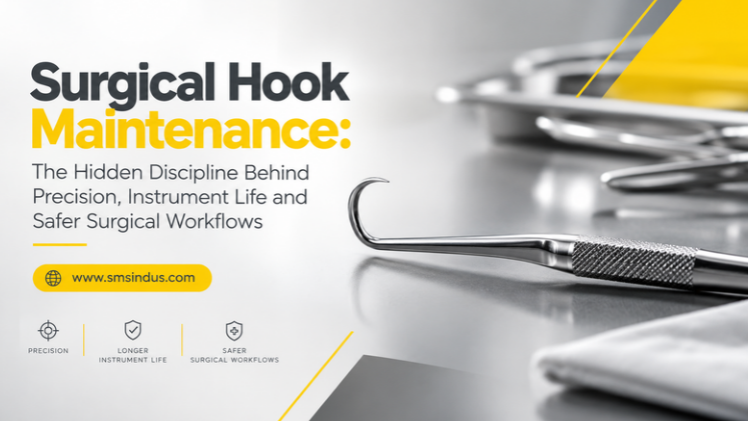
A surgical hook may look simple, but its working reliability depends on details that are easy to overlook. A hook that is properly cleaned, inspected, handled, stored, and maintained can remain a dependable part of a surgical instrument set, while neglected maintenance can gradually affect its surface, alignment, sharpness, grip, finish, and overall usability. In busy hospitals, operating theatres, clinics, and surgical facilities, maintenance is not merely an administrative task performed after a procedure. It is part of instrument quality management. For surgeons, sterile processing teams, procurement departments, and healthcare organizations, understanding how to maintain surgical hooks is therefore essential. NAZMED SMS SDN BHD and the SMS brand recognize that surgical instruments are expected to support demanding professional environments, which is why Surgical Medical Supplies should be considered from both the purchasing and lifecycle-management perspective. The real value of SMS Surgical Instruments is not simply the moment an instrument is purchased; it is how reliably that instrument continues to perform throughout its intended service life.
Clean and decontaminate promptly after use
The first principle of surgical hook maintenance is straightforward: do not allow contamination to become a maintenance problem. After use, instruments should move promptly into the facility’s established cleaning and decontamination workflow rather than being left with blood, tissue, saline, or other residues. Dried biological material can become considerably harder to remove and may interfere with inspection and subsequent processing. A surgical hook should be handled according to the manufacturer’s validated instructions and the healthcare facility’s infection prevention and reprocessing procedures. Manual cleaning, automated cleaning, enzymatic detergents, rinsing, drying, inspection, packaging, sterilization, and storage all form part of a connected process. Treating one stage casually can compromise the stages that follow. This is particularly important for Surgical Medical Supplies because the quality of an instrument cannot be separated from the process used to keep it clean, functional, and ready for its next intended use.
Inspect every hook after cleaning
Inspection is where maintenance becomes more than cleaning. Once a surgical hook has been cleaned and dried, the instrument should be examined under suitable lighting for visible damage, corrosion, discoloration, residue, deformation, cracks, rough surfaces, loose components, or changes in the working end. The hook should also be checked for structural integrity and any movement or connection points should function as intended. A small defect may not look significant during a quick visual check, but repeated use can turn minor damage into a more serious usability issue. Consider a hook that has developed a slightly distorted working tip after repeated handling. If that change goes unnoticed, the instrument may no longer interact with tissue or surgical structures in the manner expected from its original design. Quality instruments deserve quality inspection, and this is one reason hospitals should establish consistent instrument inspection practices rather than relying solely on assumptions about an instrument’s condition.
Use a suitable cleaning technique
Cleaning technique matters just as much as cleaning frequency. Aggressive scrubbing, unsuitable chemicals, excessive mechanical force, or abrasive materials can damage an instrument’s surface and gradually reduce its serviceability. Surgical hooks should be cleaned using methods compatible with the instrument material and the manufacturer’s instructions. Staff should avoid improvised maintenance techniques simply because an instrument appears particularly dirty. The short-term goal of removing residue should never be separated from the long-term objective of preserving the instrument. With professional Surgical Instruments, surface condition matters because corrosion, pitting, scratches, and damaged finishes can make future cleaning and inspection more difficult. The same principle applies across other medical products, including dental instruments and specialized surgical devices. A maintenance program should protect the instrument rather than unintentionally becoming a source of damage.
Dry instruments thoroughly
Drying deserves more attention than it usually receives. Residual moisture can contribute to corrosion and can complicate subsequent packaging and sterilization workflows. After cleaning and rinsing, surgical hooks should be dried using the method specified by the manufacturer and the facility’s validated procedures. Particular attention should be paid to joints, crevices, textured areas, and other locations where water can remain unnoticed. A surgical instrument that appears dry at first glance may still contain moisture in less visible areas. Over time, repeated exposure to moisture can affect the condition of metal surfaces. This is where disciplined maintenance begins to create measurable operational value: fewer avoidable instrument problems, more predictable inspection, better preservation of equipment, and a more organized sterile processing workflow. For healthcare facilities investing in quality instruments, protecting that investment should be treated as part of procurement strategy rather than an afterthought.
Lubrication and functional care
Lubrication and functional care should also be approached carefully. Not every surgical hook requires lubrication, and not every lubricant is appropriate for every instrument or processing system. Where the instrument design and manufacturer’s instructions require or permit lubrication, facilities should use a suitable product and apply it according to validated procedures. The objective is controlled maintenance, not excessive treatment. Applying unsuitable substances can interfere with cleaning or sterilization processes and may damage the instrument. Staff should therefore resist the temptation to use household oils, improvised products, or generic maintenance solutions simply because they are readily available. The same disciplined approach should apply when handling SMS Surgical Instruments supplied by NAZMED SMS SDN BHD: the instrument’s intended design, material, manufacturer guidance, and facility procedures should determine the maintenance method.
Store hooks in a clean, dry, protected place
Storage is another overlooked factor in surgical hook longevity. Instruments should be stored in a clean, dry, controlled environment and protected from unnecessary impact, compression, contamination, and contact with incompatible materials. Surgical hooks should not be thrown loosely into trays where their working ends can strike other instruments. When delicate or shaped working ends come into repeated contact with heavier instruments, even small changes can occur over time. Proper organization also makes inspection easier because staff can identify missing, damaged, or incorrectly placed instruments before a procedure. A professional Surgical Medical Supplies workflow should therefore consider the complete journey of an instrument, from purchase and receiving inspection through use, cleaning, sterilization, storage, inventory management, and eventual retirement. Maintenance is strongest when every stage supports the next one.
Handle instruments with care
Handling practices can either preserve or shorten the useful life of surgical instruments. Instruments should be handled deliberately rather than tossed, stacked carelessly, or forced into trays that do not accommodate their dimensions. A surgical hook should never be used for a purpose outside its intended function simply because it appears capable of doing the job. Misuse can produce deformation, scratches, mechanical stress, or other damage that may not be immediately obvious. Staff training is therefore as important as the physical maintenance process. When surgeons, nurses, sterile processing personnel, and procurement teams understand why proper handling matters, instrument care becomes part of the facility’s working culture rather than a checklist performed only when someone remembers it. This is particularly valuable for hospitals and clinics managing large inventories of Surgical Instruments, dental instruments, orthopedic instruments, and other specialized medical products.
Keep maintenance records
A strong maintenance program should also include documentation. Facilities can benefit from tracking instrument inspection findings, repairs, recurring defects, replacement patterns, and relevant maintenance activities. Documentation makes it easier to identify whether certain instruments are repeatedly developing the same problem or whether particular handling, cleaning, storage, or processing practices need review. It also helps procurement teams make better decisions when replacing or expanding instrument inventories. Instead of asking only how much a surgical hook costs at the time of purchase, decision-makers can examine durability, maintenance requirements, repairability, availability, supplier support, intended application, and lifecycle considerations. This is where the role of a professional supplier becomes important. NAZMED SMS SDN BHD, through its SMS brand and Surgical Medical Supplies offering, can be part of a procurement conversation focused not only on obtaining surgical instruments but also on selecting quality instruments appropriate for professional healthcare environments.
What procurement teams should look for
Procurement teams should also understand that “maintenance-friendly” is not simply a marketing phrase. When evaluating surgical hooks and other Surgical Instruments, buyers should examine construction quality, intended clinical application, material specifications, finish, ergonomics, cleaning compatibility, reprocessing requirements, inspection accessibility, and supplier documentation. The cheapest instrument may not represent the lowest total cost if it requires frequent replacement or becomes difficult to maintain. Conversely, a higher purchase price does not automatically guarantee better performance. The sensible approach is to evaluate the instrument against documented requirements and the environment in which it will actually be used. For hospitals, clinics, dental practices, surgical centers, and distributors, choosing the right Surgical Medical Supplies partner can influence consistency across the entire instrument inventory. NAZMED SMS SDN BHD and the SMS brand are positioned around medical products and instruments for professional users who need dependable solutions rather than generic purchasing decisions.
The human side of instrument maintenance
There is also a human side to instrument maintenance that should never be ignored. Surgical teams work in environments where precision, preparation, and consistency matter. When an instrument is damaged, poorly maintained, incorrectly stored, or unexpectedly unavailable, the problem is larger than the instrument itself. It can create delays, require replacement equipment, interrupt workflow, or force staff to spend time solving an issue that should have been prevented earlier. Good maintenance removes avoidable uncertainty. It gives healthcare professionals greater confidence that the instruments presented for a procedure have passed the necessary cleaning, inspection, processing, and readiness checks. That is the real reason surgical hook maintenance deserves serious attention. It is not about making an instrument look polished. It is about protecting the integrity of a professional workflow, preserving the useful life of valuable equipment, and supporting the consistent preparation expected from modern healthcare facilities.
Bringing it together
The smartest approach is to treat every surgical hook as part of a complete quality system rather than as an isolated metal instrument. Buy appropriately. Inspect consistently. Clean according to validated procedures. Dry thoroughly. Follow manufacturer instructions. Handle carefully. Store correctly. Document recurring problems. Remove damaged instruments from service when they no longer meet the required standard. Review supplier quality before purchasing replacement stock. These habits can transform maintenance from a routine burden into a practical asset-management strategy. For healthcare organizations looking for Surgical Medical Supplies, surgical instruments, dental instruments, and other medical products, the conversation should begin with suitability and quality rather than price alone. NAZMED SMS SDN BHD and the SMS brand are committed to serving professional requirements through SMS Surgical Instruments and quality instruments for healthcare environments. Need more information? Visit www.smsindus.com, email sales@smsindus.com, or call +60-3-8024 4401 to discuss your surgical instrument requirements.
Frequently asked questions
How should surgical hooks be cleaned after use?
Move them promptly into the facility’s established cleaning and decontamination workflow, and avoid aggressive scrubbing, unsuitable chemicals, excessive mechanical force or abrasive materials, which can damage the instrument surface over time.
What should be checked when inspecting a surgical hook?
Once cleaned and dried, the hook should be examined under suitable lighting for visible damage, corrosion, discoloration, residue, deformation and cracks.
How should surgical hooks be stored?
In a clean, dry, controlled environment, protected from unnecessary impact, compression, contamination and contact with incompatible items.
Need surgical hooks or retractors?
Browse surgical hooks and retractors or contact NAZMED SMS in Subang Jaya, Selangor, for a quotation.