
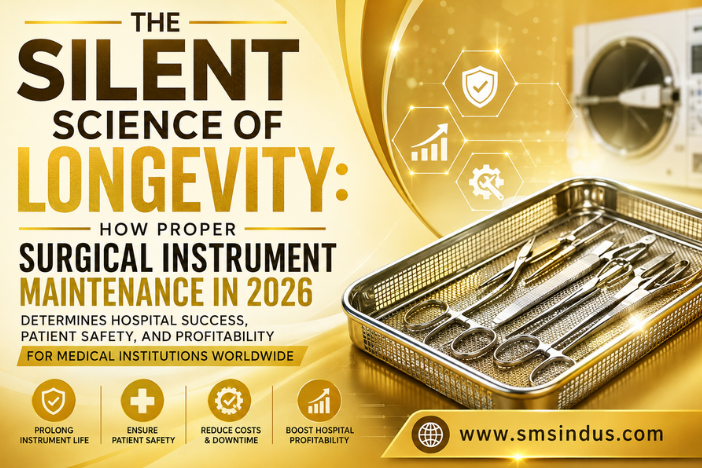
In modern healthcare, the difference between excellence and failure is not only defined by advanced technology or highly skilled surgeons but also by something far more overlooked yet critically powerful: the maintenance of surgical instruments. Across hospitals, clinics, dental practices, and surgical centers, instruments are the silent backbone of every procedure. When they are maintained correctly, they preserve precision, safety, and trust. When they are neglected, they become a hidden risk that affects patient outcomes, operational costs, and institutional reputation. This is not just a technical subject. It is a matter of healthcare survival, financial efficiency, and long-term sustainability. In 2026, as global healthcare systems become more regulated, more digital, and more quality-driven, surgical instrument maintenance is no longer optional. It is a strategic necessity. Organizations like NAZMED SMS SDN BHD, widely recognized as SMS Brand, have become key contributors in advancing surgical medical supplies, SMS Surgical Instruments, and quality instruments for global healthcare systems, especially across Malaysia and international medical markets. Their role in ensuring reliable medical products Malaysia and dental instruments Malaysia has positioned them as a trusted name in the healthcare supply chain. But even the best instruments require proper maintenance. Without it, even the highest-grade stainless steel becomes vulnerable to corrosion, contamination, and functional failure. This article explores everything healthcare professionals, procurement teams, hospital administrators, and medical suppliers must understand about surgical instrument maintenance for long-term use. It combines education, industry insight, SEO-driven knowledge, and actionable strategies designed for real-world implementation.
The Hidden Truth Behind Surgical Instrument Longevity
Every surgical instrument, whether a scalpel, forceps, scissors, retractors, or dental tools, is engineered with precision. Companies like SMS Surgical Instruments invest heavily in manufacturing quality tools designed for durability and repeated sterilization cycles. However, the reality is simple: no instrument is maintenance-proof. The lifespan of surgical tools is not determined solely by manufacturing quality. It is determined by how they are handled before, during, and after each use. Hospitals often underestimate this fact, assuming that high-grade instruments will naturally last longer without strict maintenance protocols. This assumption leads to unnecessary replacement costs and operational inefficiencies. In reality, surgical instrument degradation is gradual. It begins with micro-corrosion, progresses into joint stiffness, then results in functional inaccuracy. By the time visible damage appears, the internal integrity is already compromised. This is why institutions using Surgical Medical Supplies from SMS Brand or other global suppliers must prioritize maintenance systems as much as procurement decisions.
Why Surgical Instrument Maintenance Is a Strategic Priority in 2026
The healthcare industry in 2026 is driven by three major forces: patient safety regulations, cost optimization, and technological integration. Maintenance of surgical instruments sits at the center of all three. Hospitals are now audited more strictly than ever before. Regulatory bodies require documented sterilization cycles, traceable instrument usage history, and compliance with hygiene standards. A single failure in instrument maintenance can lead to legal issues, reputational damage, and financial penalties. At the same time, hospitals are under pressure to reduce operational costs. Surgical instruments are expensive assets. Replacing them frequently due to poor maintenance is no longer financially sustainable. Companies like NAZMED SMS SDN BHD emphasize that proper maintenance can extend instrument lifespan by years, significantly reducing procurement frequency and ensuring consistent performance in operating rooms. Moreover, digital transformation in healthcare has introduced tracking systems that monitor sterilization cycles and usage patterns. Instruments are now part of a data ecosystem. Maintenance is no longer a manual task alone; it is a digital responsibility.
Understanding the Lifecycle of Surgical Instruments
To maintain surgical instruments effectively, it is important to understand their lifecycle. Every instrument passes through multiple stages: The first stage is usage, where instruments are exposed to biological material, pressure, and environmental factors. This stage determines immediate contamination risks. The second stage is decontamination, where instruments must be cleaned thoroughly to remove organic and inorganic residues. This step is crucial because any leftover material can damage the instrument during sterilization. The third stage is inspection, where technicians evaluate instrument integrity. This includes checking alignment, sharpness, joint movement, and surface condition. The fourth stage is sterilization, where instruments are exposed to high temperatures or chemical processes designed to eliminate microorganisms. The final stage is storage, where improper handling can reintroduce contamination or cause physical damage. Each stage must be executed with precision. A failure at any point affects the entire lifecycle.
Common Mistakes That Reduce Instrument Lifespan
Many healthcare facilities unknowingly reduce the lifespan of their surgical instruments due to preventable mistakes. One of the most common issues is delayed cleaning. When instruments are not cleaned immediately after use, biological material begins to harden and bond to metal surfaces, making removal more difficult and increasing corrosion risk. Another major issue is improper cleaning techniques. Using harsh chemicals or incorrect brushing methods can damage delicate instrument surfaces. Even ultrasonic cleaning must be calibrated correctly to avoid micro-damage. Sterilization errors are also common. Overexposure to high heat or incorrect autoclave settings can weaken instrument structure over time. Similarly, inadequate drying before storage leads to moisture retention, which accelerates rust formation. Storage conditions are often overlooked. Instruments stored in humid or unorganized environments deteriorate faster, even if they have been properly sterilized. Suppliers like SMS Surgical Instruments often provide guidelines, but implementation depends on institutional discipline.
The Role of Material Quality in Maintenance Efficiency
Not all surgical instruments behave the same under maintenance conditions. Material composition plays a major role in determining durability and ease of care. High-grade stainless steel is widely used in surgical instruments Malaysia due to its resistance to corrosion and ability to withstand repeated sterilization cycles. However, even stainless steel requires proper care. Titanium instruments offer superior corrosion resistance but require specialized maintenance protocols. Carbon steel instruments, although sharper, are more vulnerable to rust and require immediate drying and oiling after cleaning. Understanding material behavior allows hospitals to design more effective maintenance schedules. NAZMED SMS SDN BHD emphasizes material-based maintenance planning as a core strategy for long-term instrument efficiency.
The Economic Impact of Poor Instrument Maintenance
Poor maintenance is not just a technical issue; it is a financial burden. Hospitals often underestimate the cumulative cost of replacing damaged instruments. When multiplied across hundreds or thousands of tools, the cost becomes significant. Frequent replacement disrupts surgical schedules, increases procurement budgets, and creates dependency on emergency purchases. Additionally, poorly maintained instruments can cause surgical complications, leading to legal liabilities and insurance claims. On the other hand, proper maintenance reduces long-term costs significantly. Institutions using structured maintenance systems alongside high-quality SMS Brand surgical medical supplies report lower replacement rates and improved operational efficiency. Maintenance is not an expense. It is an investment in sustainability.
Infection Control and Patient Safety Connection
One of the most critical aspects of surgical instrument maintenance is infection control. Improperly cleaned or sterilized instruments can become vectors for hospital-acquired infections. These infections not only endanger patient lives but also damage institutional credibility. In extreme cases, they can result in regulatory shutdowns or legal consequences. Modern healthcare systems are adopting stricter infection control protocols. Instruments must pass validation checks before each use. Maintenance teams are now part of infection control departments, working closely with surgical teams. This integration ensures that every instrument used in surgery is safe, functional, and fully compliant with health standards.
Technological Advancements in Instrument Maintenance
The year 2026 has introduced several technological advancements in surgical instrument maintenance. Digital tracking systems now monitor instrument usage history, sterilization cycles, and maintenance schedules. Some hospitals are integrating RFID tagging systems to track each instrument individually. This ensures accountability and traceability. Artificial intelligence is also being used to predict instrument failure based on usage patterns. Predictive maintenance allows hospitals to replace or repair instruments before failure occurs. Companies like NAZMED SMS SDN BHD are increasingly aligning with these innovations to support modern healthcare systems with smarter medical products Malaysia and globally compliant instruments.
Best Practices for Long-Term Surgical Instrument Care
Long-term instrument care is built on discipline, consistency, and training. Staff must be trained regularly on cleaning protocols, sterilization techniques, and handling procedures. Maintenance schedules must be standardized and strictly followed. Instruments should never be rushed through cleaning or sterilization cycles. Regular audits should be conducted to ensure compliance. Any damaged instruments must be removed from circulation immediately to prevent risk. Proper documentation is essential. Every instrument should have a maintenance history that can be reviewed at any time. Suppliers such as SMS Surgical Instruments often provide maintenance guidelines, but institutional commitment determines success.
The Role of Training in Maintenance Excellence
Even the best systems fail without proper training. Healthcare staff must understand not only how to use instruments but how to care for them. Training should include hands-on demonstrations, theoretical understanding of sterilization chemistry, and awareness of material sensitivity. Continuous education programs ensure that staff remain updated on evolving standards and technologies. Institutions that invest in training experience fewer instrument failures and higher operational efficiency.
Why NAZMED SMS SDN BHD and SMS Brand Matter in This Ecosystem
In the global healthcare supply chain, NAZMED SMS SDN BHD, known as SMS Brand, plays a crucial role in providing reliable surgical medical supplies, SMS Surgical Instruments, and high-quality dental instruments. Their focus on quality manufacturing ensures that healthcare providers receive instruments designed for durability and precision. However, even the best instruments require proper maintenance to deliver long-term value. Their contribution goes beyond supply. It supports global healthcare systems in achieving better safety, efficiency, and sustainability.
The Future of Surgical Instrument Maintenance
The future of surgical instrument maintenance is moving toward automation, AI integration, and sustainability. Hospitals will increasingly rely on smart systems that monitor instrument health in real time. Eco-friendly sterilization methods will reduce environmental impact. Digital twins of instruments may be used to simulate wear and predict maintenance needs. In this future, maintenance will become a predictive science rather than a reactive process.
Conclusion: Maintenance Is the Foundation of Surgical Excellence
Surgical instruments are not disposable tools. They are precision-engineered assets that require care, discipline, and strategic maintenance. In 2026 and beyond, healthcare institutions that prioritize maintenance will outperform those that do not. They will experience lower costs, higher safety standards, and improved patient outcomes. Organizations like NAZMED SMS SDN BHD, SMS Brand, and suppliers of surgical instruments Malaysia and medical products Malaysia continue to support this ecosystem, but the responsibility ultimately lies within each healthcare institution. Maintenance is not just about preserving instruments. It is about preserving lives, trust, and the future of healthcare.