


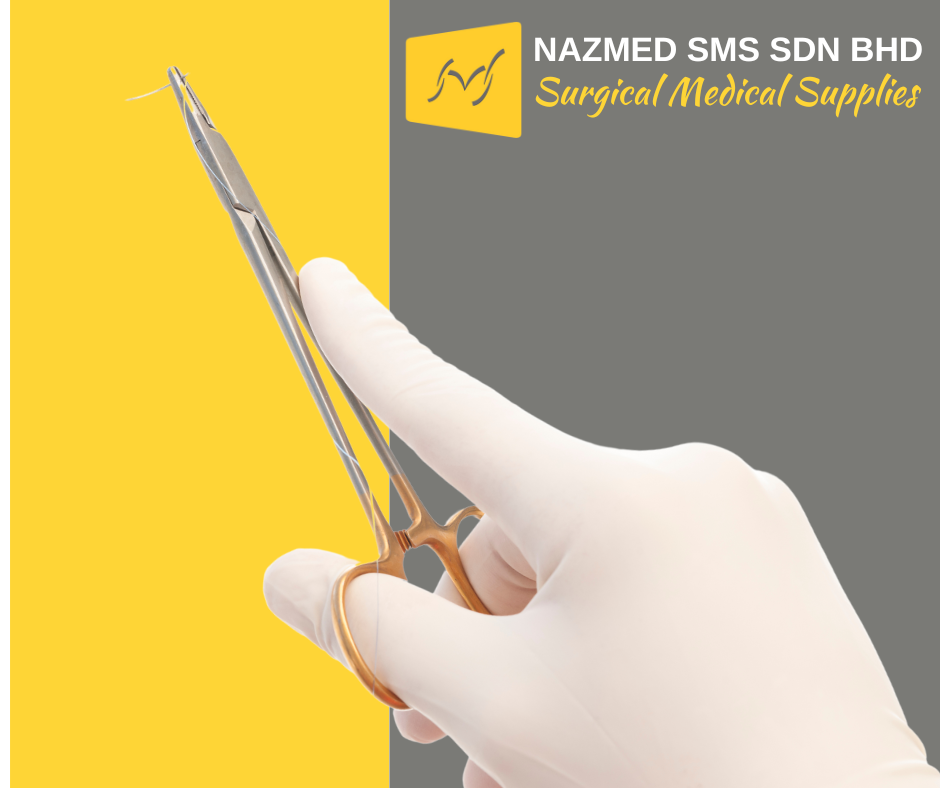
In short: needle holder designs differ in four places: the jaw surface (smooth, serrated, cross-serrated with groove, fenestrated or tungsten carbide), the jaw shape (straight, curved or bayonet), the handle (finger rings, plier handle or spring handle) and the lock (ratchet or catch). Some patterns add built-in scissors. Each feature changes how the instrument grips the needle and how it sits in the hand.
For an overview of the instrument and our ranges, see our guide to needle holders.
Jaw surfaces
| Jaw surface | What it does | Examples on our site |
|---|---|---|
| Smooth | Causes the least damage to the needle | Webster, Castroviejo |
| Serrated or cross-serrated | Holds the needle more tightly | Crile-Wood, Baumgartner |
| Cross-serrated with a central groove | The groove seats the needle | Mayo-Hegar, Derf |
| Fenestrated | An opening in one or both jaws | Adson, Collier |
| Tungsten carbide (TC) inserts | A harder gripping surface | Needle Holders TC |
For the material comparison, see our stainless steel vs tungsten carbide guide.
Jaw shape and length
Most needle holders are straight. Curved versions are listed for several micro patterns and for the Heaney-Hegar pattern, and bayonet-shaped versions for the Masson-Luethy pattern. Listed lengths in the surgical range run from 100 mm to 275 mm; the TC range includes longer patterns.
Handles
- Finger rings: the standard form, used on Mayo-Hegar, Hegar, Crile-Wood, Derf and most other patterns. The Neivert pattern has one offset ring.
- Plier handle: Mathieu holders have a plier-style handle with a spring. They are opened and closed by squeezing in the palm.
- Spring handle: Castroviejo and Barraquer micro holders have a double spring handle that is held like a pen.
Locks
- Ratchet: interlocking steps between the finger rings hold the jaws closed, so the hand can relax its grip between stitches.
- Ratchet at the handle base: on Mathieu holders, squeezing locks and squeezing again releases.
- Catch or no catch: micro holders are listed with a catch (lock) or without one. Without a catch, the needle is held only while the handle is squeezed.
Built-in scissors
Hegar-Olsen and Gillies needle holders include suture scissors in the same instrument, so the suture can be cut without picking up a second instrument.
Reusable and single-use construction
The same patterns are made as reusable instruments and, for some, as sterile disposables. See the single-use Derf needle holder guide for an example.
How to use this when choosing
Start from the needle and suture, then pick the jaw surface, handle and lock that suit the work. See how to choose the right needle holder and types of needle holders.
Frequently asked questions
What is the groove in a needle holder jaw for?
The central groove seats the needle so that it sits securely between the cross-serrated surfaces.
What does “with catch” mean on a micro needle holder?
It means the holder has a lock that keeps the jaws closed. A holder without a catch grips only while the handle is squeezed.
Why do some needle holders have a plier handle?
Mathieu-type holders are opened, closed and locked by squeezing the handles in the palm, which some users prefer to finger rings.
Looking for a particular needle holder design?
Browse the product ranges above or contact NAZMED SMS in Subang Jaya, Selangor, for a quotation: sales@smsindus.com or +60 3-8024 4401.