

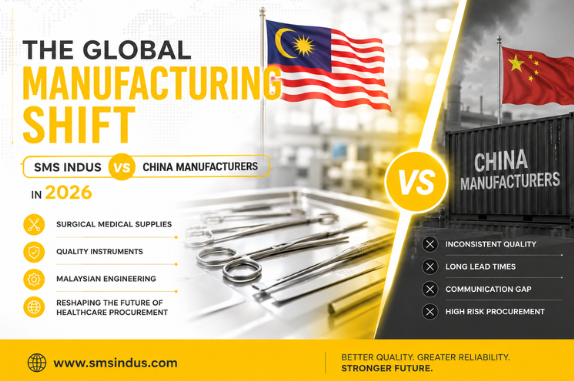
In today’s rapidly evolving global healthcare supply chain, the competition between established Asian manufacturing hubs has reached a decisive turning point. Hospitals, distributors, procurement officers, and medical traders are no longer simply comparing prices. They are comparing survival factors: quality consistency, compliance standards, long-term cost efficiency, traceability, and trust. In this transformation, the comparison between SMS Indus, represented by NAZMED SMS SDN BHD and large-scale China manufacturers is becoming one of the most critical discussions in surgical medical supplies and surgical instruments Malaysia and global procurement ecosystems.
This is not just a comparison of two supply sources. It is a reflection of how the medical industry is moving from mass production dependency toward precision manufacturing accountability. It is also a story of how brands like SMS brand, surgical medical supplies innovators in Malaysia, are stepping into a space traditionally dominated by China’s large manufacturing ecosystem.
The global healthcare market in 2026 is shaped by one truth: procurement mistakes are no longer just financial losses, they are clinical risks.
The new reality of medical procurement in 2026
The medical supply chain is undergoing structural disruption. Previously, China manufacturers dominated global surgical instruments due to scale, speed, and cost efficiency. Hospitals across Asia, Africa, and even parts of Europe depended heavily on Chinese OEM production for everything from basic surgical kits to advanced precision tools.
However, the post-pandemic world has permanently changed procurement psychology. Buyers are now prioritizing three core principles: verified quality, regulatory compliance, and predictable long-term performance. This is where Malaysian manufacturers such as SMS Indus and NAZMED SMS SDN BHD are gaining strategic relevance.
Unlike traditional bulk manufacturing models, SMS Surgical Instruments and Surgical Medical Supplies Malaysia brands are increasingly focusing on controlled production environments, stricter quality assurance processes, and alignment with international medical device standards.
China manufacturers still dominate in volume, but the question in 2026 is no longer “who can produce more” but “who can be trusted when it matters most”.
Understanding SMS Indus and Malaysian surgical manufacturing advantage
The rise of SMS brand, surgical instruments Malaysia, and quality instruments manufacturing in Malaysia is not accidental. It is built on a combination of industrial policy evolution, healthcare demand sophistication, and export-driven quality benchmarking.
Malaysia’s medical manufacturing ecosystem benefits from several structural advantages. First is regulatory alignment. Malaysian manufacturers often align production with international frameworks such as ISO medical device standards and CE-equivalent quality expectations for export markets. This creates a more controlled and traceable production environment compared to fragmented OEM subcontracting models.
Second is specialization. Unlike mass production-heavy ecosystems, SMS Indus and NAZMED SMS SDN BHD focus on surgical medical supplies, dental instruments Malaysia, and precision healthcare tools where consistency matters more than sheer output volume.
Third is accountability in supply chain transparency. Buyers increasingly demand traceability in materials, steel composition, sterilization processes, and lifecycle durability. Malaysian manufacturers are adapting faster to these demands.
In contrast, many China manufacturers operate at massive scale but with varying quality tiers depending on supplier clusters, OEM outsourcing layers, and cost optimization strategies.
China manufacturers: scale dominance and evolving challenges
China remains a global powerhouse in manufacturing surgical instruments. Its ecosystem is built on unmatched production capacity, vertically integrated supply chains, and extremely competitive pricing structures.
For hospitals with limited budgets or bulk procurement needs, China manufacturers continue to offer strong value propositions. They dominate categories such as disposable surgical supplies, basic instrument sets, and standardized mass-market medical tools.
However, challenges are becoming more visible in global procurement discussions. One of the major concerns is inconsistency between production batches when working with different OEM suppliers. Another is the complexity of verifying compliance documentation across multiple manufacturing subcontractors.
In high-stakes surgical environments, even small inconsistencies in instrument quality can affect surgical outcomes. This is why premium procurement departments are increasingly diversifying their sourcing strategies instead of relying solely on low-cost mass manufacturing hubs.
Why SMS Indus represents a strategic shift in surgical instruments Malaysia
The emergence of SMS brand and surgical medical supplies Malaysia companies reflects a broader industry transition from cost-driven procurement to risk-managed procurement.
NAZMED SMS SDN BHD represents this shift by focusing on structured quality systems, controlled production lines, and closer alignment with healthcare institutional requirements.
Unlike generic global sourcing models, SMS Indus emphasizes product consistency across batches, which is critical in surgical environments where instrument performance must remain identical over time.
Hospitals are increasingly recognizing that procurement decisions are no longer just supply chain decisions. They are clinical governance decisions.
The hidden cost comparison most buyers ignore
At first glance, China manufacturers appear more cost-effective. The unit price of surgical instruments, dental tools, and medical kits is often significantly lower. However, procurement professionals in 2026 are now calculating total cost of ownership instead of unit cost.
Total cost of ownership includes replacement frequency, sterilization durability, failure rates, surgical interruptions, and compliance risks. When these factors are considered, lower upfront cost does not always translate into lower long-term expenditure.
SMS Surgical Instruments Malaysia providers often reduce hidden costs by offering higher durability and more stable performance. This reduces replacement cycles and improves surgical workflow reliability.
In contrast, lower-cost imports may introduce variability that increases long-term procurement uncertainty.
Surgical precision and the importance of material engineering
One of the most critical differentiators between SMS Indus and China manufacturers lies in material engineering standards. Surgical instruments require specific stainless steel grades, precise heat treatment processes, and exact finishing techniques to ensure durability and sterilization resistance.
Malaysian manufacturers like SMS brand surgical medical supplies providers are increasingly emphasizing controlled engineering processes that prioritize long-term clinical reliability over rapid mass output.
China manufacturers also produce high-quality instruments, but the variability between premium OEM factories and low-cost subcontractors can create inconsistency in final product quality depending on sourcing channels.
Dental instruments Malaysia and specialized medical categories
The demand for dental instruments Malaysia has grown significantly due to expanding private dental clinics and medical tourism in Southeast Asia. This category requires extremely high precision, as dental procedures rely on micro-level accuracy and ergonomic reliability.
SMS Indus and similar Malaysian manufacturers are strengthening their position in this niche by focusing on quality control and ergonomic design optimization.
China manufacturers continue to supply bulk dental tools globally, but premium dental clinics increasingly prefer suppliers with consistent quality assurance systems.
Procurement psychology shift in hospitals and distributors
The most important transformation in 2026 is not technological, but psychological. Procurement teams are no longer evaluated solely on cost savings. They are evaluated on risk prevention, compliance adherence, and operational reliability.
This shift has created a growing preference for suppliers like SMS brand surgical instruments Malaysia providers who can offer traceability, documentation transparency, and predictable product lifecycle performance.
China manufacturers still dominate procurement pipelines, but decision-making authority is gradually shifting toward quality assurance departments rather than purely financial procurement units.
Why quality instruments are becoming a global standard expectation
Healthcare systems worldwide are under pressure to reduce surgical complications, improve patient outcomes, and minimize operational delays. As a result, quality instruments are no longer premium options; they are baseline requirements.
Manufacturers like SMS Indus are aligning themselves with this global expectation by positioning quality as the default manufacturing standard rather than an upgrade option.
This shift is particularly visible in export markets where regulatory inspections are becoming stricter and documentation requirements are more detailed.
Digital transformation and surgical supply chain traceability
One of the emerging trends in 2026 is digital traceability in medical supply chains. Hospitals are beginning to require digital records for instrument batches, sterilization logs, and manufacturing certification tracking.
Malaysian manufacturers are adopting these systems more rapidly due to smaller, more controlled production ecosystems. SMS Indus and NAZMED SMS SDN BHD are increasingly integrating documentation-driven compliance frameworks that support hospital audit requirements.
China manufacturers are also advancing in this area, but adoption varies widely across suppliers due to scale and fragmentation.
The future of SMS brand in global medical trade
The SMS brand is gradually transitioning from a regional supplier identity to a globally recognized quality-driven manufacturer category. Surgical medical supplies Malaysia are increasingly seen as part of a “mid-to-premium quality tier” that balances affordability with reliability.
This positions SMS Indus as a strategic alternative for hospitals that want to reduce dependency on single-source manufacturing regions while maintaining cost control.
Actionable insights for procurement decision makers
Procurement teams evaluating SMS Indus vs China manufacturers should focus on five core evaluation pillars: quality consistency across batches, certification transparency, long-term durability, supplier accountability, and post-sale support systems.
In 2026, successful procurement is not about choosing the cheapest supplier. It is about choosing the least risky supplier over a five to ten-year operational horizon.
Why this comparison matters more than ever
The comparison between SMS Indus and China manufacturers is not a competition of nations. It is a reflection of how global healthcare is evolving toward accountability-driven sourcing.
Malaysia’s surgical medical supplies ecosystem is not trying to replace China. Instead, it is offering an alternative procurement philosophy: smaller scale, higher consistency, and stronger quality governance.
China manufacturers continue to dominate global supply in volume, but Malaysia is emerging in precision-focused categories where trust, consistency, and compliance matter more than scale.
Frequently asked questions
What is the difference between SMS Indus and China manufacturers in surgical instruments quality?
SMS Indus focuses on controlled production and consistency, while China manufacturers vary widely depending on OEM scale and cost structure.
Are SMS brand surgical instruments suitable for hospitals?
Yes, SMS brand surgical instruments Malaysia are designed for clinical environments where durability and consistency are critical.
Why are medical products Malaysia gaining attention globally?
Due to improved manufacturing standards, better compliance alignment, and growing demand for traceable quality instruments.
Is China still dominant in surgical medical supplies?
Yes, China remains dominant in global volume production, especially for low-cost and disposable instruments.
Why are hospitals shifting toward Malaysian suppliers?
Hospitals are prioritizing risk reduction, consistency, and regulatory compliance over purely cost-driven procurement.
Need more information
Visit our website: www.smsindus.com
Email us: sales@smsindus.com
Call us: +60-3-8024 4401