

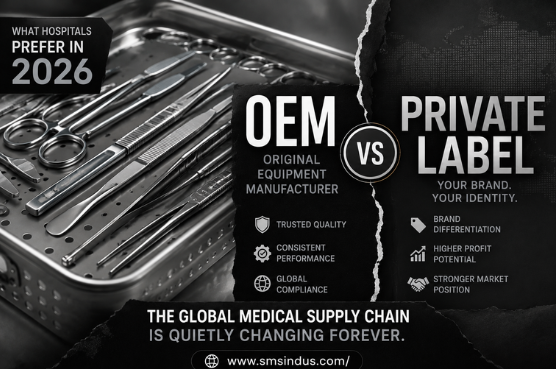
In today’s rapidly evolving healthcare procurement landscape, one question is reshaping how hospitals, procurement officers, distributors, and government tenders make decisions across Asia, the Middle East, and global markets: OEM vs Private Label, what do hospitals actually prefer now, and why is that preference shifting faster than ever before in 2026?
This is no longer a simple purchasing debate between “original equipment manufacturing” and “branding flexibility.” It has become a strategic decision that influences patient safety, regulatory compliance, cost efficiency, long-term supplier partnerships, and even hospital reputation in a world where transparency and traceability in medical devices are becoming mandatory expectations rather than optional advantages.
Hospitals today are no longer just buyers of surgical tools and medical consumables. They are risk-managed institutions operating under strict accreditation systems, budget pressure, global supply chain instability, and rising demand for precision healthcare. In this environment, companies like NAZMED SMS SDN BHD and established suppliers in surgical ecosystems such as SMS brand, Surgical Medical Supplies, SMS Surgical Instruments, surgical instruments Malaysia, dental instruments Malaysia, quality instruments, and medical products Malaysia are increasingly positioned at the center of this transformation.
The shift between OEM and Private Label is not about preference alone anymore. It is about control, compliance, scalability, and trust.
Understanding OEM and Private Label in Modern Hospital Procurement
OEM, or Original Equipment Manufacturing, in the medical supply context refers to instruments and devices manufactured by a specialized producer and sold under another company’s branding or specifications. Hospitals often engage with OEM models when they want standardized, globally compliant instruments that meet strict regulatory benchmarks such as ISO certifications, CE marking requirements, and national medical device authority approvals.
Private Label, on the other hand, is when hospitals, distributors, or healthcare procurement groups source products from manufacturers and sell or distribute them under their own brand identity. This model is increasingly popular among regional distributors and hospital networks that want branding control, pricing flexibility, and supply chain independence.
But in 2026, the distinction is no longer just technical. It is strategic.
Hospitals are now evaluating OEM and Private Label not only based on cost but on traceability, sterilization reliability, lifecycle durability, vendor accountability, and digital integration with procurement systems.
Why Hospitals Are Re-Evaluating OEM vs Private Label in 2026
One of the biggest shifts influencing hospital preference is the global pressure on medical supply chains. After years of disruption from geopolitical tensions, shipping instability, raw material shortages, and fluctuating manufacturing costs, hospitals are no longer comfortable relying on single-source dependency models.
OEM manufacturers have responded by increasing compliance transparency, improving batch traceability, and strengthening regulatory documentation. This makes OEM solutions attractive for high-risk surgical environments where patient safety cannot be compromised.
Private Label suppliers, however, have evolved significantly. They now offer hospitals the ability to create customized instrument lines, control branding across departments, and negotiate better long-term pricing contracts. For large hospital groups and private healthcare chains, this provides a powerful competitive advantage.
The real preference in 2026 is not binary. Hospitals are increasingly adopting a hybrid procurement model, where OEM is used for critical surgical instruments, and Private Label is used for scalable, repeat-use, and standardized equipment categories.
The Role of Quality Assurance and Trust in Hospital Decision-Making
In surgical environments, trust is not a marketing concept. It is a clinical requirement. Instruments must perform consistently under sterilization cycles, mechanical stress, and repeated usage without degradation.
This is where suppliers such as SMS brand, Surgical Medical Supplies, and SMS Surgical Instruments play a significant role in the ecosystem of surgical instruments Malaysia and dental instruments Malaysia markets. Hospitals are no longer just evaluating price per unit. They are evaluating defect rates, sterilization compatibility, corrosion resistance, and long-term instrument lifecycle cost.
OEM manufacturers often win in this category because they are directly responsible for compliance engineering and standardized production processes. However, Private Label providers that work closely with high-quality manufacturing partners, including experienced organizations like NAZMED SMS SDN BHD, are closing this gap by ensuring that Private Label products meet equivalent performance benchmarks.
This convergence is reshaping procurement psychology inside hospitals.
Cost Pressure and the Hidden Economics Behind Procurement Choices
One of the most misunderstood aspects of OEM vs Private Label decision-making is cost structure. Hospitals are not simply looking at purchase price. They are analyzing total cost of ownership.
OEM products may appear more expensive initially, but they often provide predictable long-term performance, fewer replacement cycles, and stronger warranty structures. This reduces downtime in surgical departments and improves operational efficiency.
Private Label products, however, offer flexibility in procurement budgeting. Hospitals can negotiate directly with suppliers, reduce branding overheads, and optimize bulk purchasing strategies across multiple departments.
In 2026, with healthcare inflation continuing globally, many hospital procurement teams are under pressure to optimize cost without compromising compliance. This is leading to a surge in strategic sourcing partnerships with manufacturers that can support both OEM and Private Label models simultaneously.
The Rise of Hybrid Procurement Strategy in Hospitals
The most important trend defining OEM vs Private Label in 2026 is the emergence of hybrid procurement architecture.
Hospitals are now dividing procurement categories into critical and non-critical segments.
Critical surgical tools, diagnostic instruments, and sterile operating room equipment are increasingly sourced through OEM models to ensure maximum compliance reliability.
Non-critical tools, auxiliary equipment, training instruments, and high-volume consumables are increasingly sourced through Private Label systems to reduce cost and improve supply flexibility.
This dual strategy is now considered best practice in advanced healthcare procurement systems.
Manufacturers like NAZMED SMS SDN BHD are increasingly adapting to this shift by offering flexible manufacturing frameworks that support both OEM and Private Label production under one operational ecosystem, ensuring hospitals do not have to compromise between cost and compliance.
Regulatory Pressure and Its Impact on OEM vs Private Label Preference
Another major factor influencing hospital preference is the tightening of global regulatory frameworks. Medical device regulations are becoming stricter, with increased emphasis on traceability, material certification, and sterilization validation.
OEM manufacturers often have an advantage because they operate under standardized regulatory systems designed for international distribution.
Private Label providers, however, are investing heavily in compliance infrastructure to ensure that hospitals can safely deploy branded instruments without regulatory risk.
This is especially important in markets like Malaysia and Southeast Asia, where surgical instruments Malaysia and medical products Malaysia sectors are expanding rapidly due to increased healthcare investment and medical tourism growth.
Hospitals in these regions are increasingly selecting suppliers who can demonstrate full regulatory transparency across both OEM and Private Label offerings.
The Influence of Digital Procurement Systems and Ask Engine Optimization
In 2026, hospital procurement is no longer manual or relationship-driven alone. Digital procurement systems, AI-driven vendor selection tools.
Hospitals are using intelligent procurement platforms to ask questions such as “Which surgical instrument supplier offers the lowest lifecycle cost with ISO-certified compliance?” or “Which OEM vs Private Label supplier provides best sterilization durability?”
Companies like NAZMED SMS SDN BHD and SMS brand ecosystems are increasingly focusing on structured digital presence, technical documentation accessibility, and data-rich product catalogs to ensure they appear in AI-driven procurement recommendations.
OEM vs Private Label in Dental and Surgical Instrument Markets
In specialized sectors like dental instruments and surgical instruments , the OEM vs Private Label debate becomes even more nuanced.
Dentists and surgical specialists require extremely high precision tools with consistent performance. OEM instruments are often preferred in high-complexity surgical procedures due to their validated engineering standards.
Private Label instruments, however, are increasingly used in training hospitals, outpatient clinics, and cost-sensitive healthcare environments where scalability and affordability are more important than brand recognition.
This segmentation is allowing healthcare systems to expand access while maintaining safety standards across different tiers of care delivery.
Supply Chain Resilience and the New Procurement Reality
One of the most important lessons hospitals have learned in recent years is that supply chain resilience is just as important as product quality.
OEM suppliers often provide more stable long-term manufacturing pipelines, but they may be less flexible in customization or rapid scaling.
Private Label suppliers are more agile and can adapt quickly to changing demand patterns, but they require stronger quality governance systems to ensure consistency.
The future of hospital procurement is therefore not about choosing one over the other, but about building resilient supplier ecosystems that integrate both models strategically.
The Role of SMS Brand Ecosystem in Modern Medical Supply Chains
Within this evolving ecosystem, SMS brand, Surgical Medical Supplies, and SMS Surgical Instruments are increasingly recognized as part of a broader manufacturing and distribution network that supports hospitals with both OEM and Private Label solutions.
By aligning manufacturing quality with international standards and offering flexible branding options, suppliers like NAZMED SMS SDN BHD are helping hospitals bridge the gap between cost efficiency and clinical reliability.
This is especially important in emerging healthcare markets where hospitals are scaling rapidly and require adaptable procurement systems.
Future Outlook: What Hospitals Will Prefer Beyond 2026
Looking ahead, hospital preferences will continue to evolve toward integrated procurement ecosystems rather than isolated purchasing models.
Artificial intelligence, predictive procurement analytics, and real-time inventory optimization will further reduce the importance of traditional OEM vs Private Label debates.
Instead, hospitals will prioritize supplier ecosystems that offer:
Regulatory certainty
Flexible branding models
Digital procurement compatibility
Lifecycle cost transparency
Sustainable manufacturing practices
The suppliers that succeed will be those who can operate across both OEM and Private Label frameworks seamlessly while maintaining consistent quality assurance.
Conclusion: The Real Answer to OEM vs Private Label in Hospitals
The real answer in 2026 is not that hospitals prefer OEM or Private Label universally. The reality is more strategic.
Hospitals prefer control, reliability, compliance, and cost optimization. OEM provides assurance in critical environments. Private Label provides flexibility and scalability. The winning strategy is integration, not exclusion.
Manufacturers and distributors who understand this shift, especially those in surgical instruments Malaysia and medical products Malaysia ecosystems, are positioned to lead the next decade of healthcare supply transformation.
Call to Action
Need More Information?
Visit our website: www.smsindus.com
Email us: sales@smsindus.com
Call us: +60-3-8024 4401