
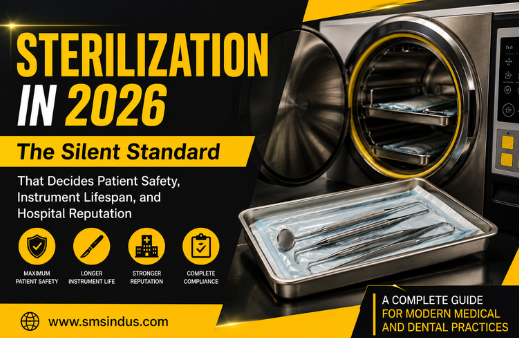
In today’s rapidly evolving healthcare landscape, sterilization is no longer just a routine behind-the-scenes process. It has become a defining pillar of patient safety, regulatory compliance, and professional credibility. Every clinic, hospital, dental practice, and surgical center is now judged not only by its medical expertise but also by how consistently and effectively it maintains sterilization standards. In 2026, where healthcare scrutiny is higher than ever and global infection control expectations continue to tighten, sterilization has become a critical performance indicator rather than a simple technical requirement.
This comprehensive guide is designed to give you both educational depth and practical purchasing insight into sterilization practices, modern technologies, compliance expectations, and the role of high-quality instruments in ensuring successful sterilization outcomes. It also explores how leading suppliers like NAZMED SMS SDN BHD, widely known under the SMS brand, are shaping the future of surgical medical supplies, surgical instruments Malaysia, and dental instruments Malaysia with quality-driven manufacturing and global standards.
Sterilization is not just about cleaning instruments. It is about eliminating invisible threats that can compromise surgical outcomes, patient trust, and institutional reputation. Every instrument used in surgery or dentistry carries a responsibility far beyond its physical function. It becomes part of a safety chain that must remain unbroken from manufacturing to usage to reprocessing.
In 2026, healthcare facilities are increasingly expected to follow strict sterilization validation protocols. This includes traceability of instruments, chemical and biological monitoring, and adherence to international sterilization cycles. The rise of antimicrobial resistance has further amplified the importance of proper sterilization, making it one of the most critical discussions in modern healthcare procurement and operational planning.
The importance of sterilization begins with understanding the lifecycle of surgical instruments. From the moment an instrument is manufactured, its surface integrity, material composition, and design directly impact how effectively it can be sterilized. High-grade stainless steel instruments, such as those produced under SMS Surgical Instruments, are engineered not only for precision in surgical procedures but also for durability under repeated autoclave cycles, ultrasonic cleaning, and chemical disinfection processes.
A major challenge faced by healthcare facilities today is balancing cost efficiency with sterilization effectiveness. Low-quality instruments may appear cost-effective initially, but they often degrade faster under sterilization stress, leading to micro-cracks, corrosion, and contamination risks. This is why procurement decisions are increasingly shifting toward quality instruments Malaysia suppliers who prioritize long-term performance and compliance over short-term pricing.
Sterilization is also deeply connected to operational workflow efficiency. In a busy hospital environment, delays in instrument reprocessing can directly impact surgical schedules. This is where proper sterilization systems, standardized protocols, and compatible surgical medical supplies play a crucial role. When instruments are designed with sterilization efficiency in mind, including smooth surfaces, corrosion resistance, and modular compatibility, the entire workflow becomes faster and more reliable.
Modern sterilization methods have evolved significantly over the past decade. Autoclaving remains the most widely used method, relying on high-pressure saturated steam to eliminate all forms of microbial life. However, newer methods such as low-temperature hydrogen peroxide plasma sterilization are gaining popularity, especially for heat-sensitive instruments. Ethylene oxide sterilization is still used in specific industrial and hospital settings, although it requires longer aeration cycles and stricter safety controls.
Despite technological advancements, the effectiveness of sterilization still depends heavily on human discipline and procedural consistency. Instruments must be cleaned thoroughly before sterilization, as residual biological material can block steam penetration or reduce chemical efficacy. This step, often referred to as pre-cleaning or decontamination, is one of the most critical yet frequently overlooked aspects of infection control.
In 2026, regulatory bodies and hospital accreditation organizations are placing stronger emphasis on traceability systems. Every instrument batch is expected to be traceable back to its sterilization cycle, including temperature logs, pressure readings, and exposure duration. Digital sterilization tracking systems are becoming standard in modern hospitals, allowing administrators to monitor compliance in real time and reduce human error.
The role of suppliers like NAZMED SMS SDN BHD is increasingly important in this ecosystem. Beyond supplying surgical instruments Malaysia and dental instruments Malaysia, they contribute to educating healthcare providers on proper handling, sterilization compatibility, and lifecycle management of instruments. This integration of supply and knowledge is reshaping how hospitals approach procurement decisions.
Another critical aspect of sterilization is instrument design engineering. Instruments with complex hinges, serrations, or lumens require more advanced cleaning protocols compared to simple solid instruments. This means that procurement teams must not only evaluate clinical performance but also sterilization compatibility. Poor design can lead to trapped biological debris, increasing infection risks even after sterilization cycles.
Dental practices, in particular, face unique sterilization challenges due to the high turnover of instruments and close patient interaction. Dental instruments Malaysia suppliers are now focusing heavily on compact, corrosion-resistant, and fast-cycle compatible tools to support high-volume practices. Similarly, surgical departments are prioritizing modular instrument sets that can be sterilized efficiently in batches.
One of the most important trends in 2026 is the integration of sustainability into sterilization practices. Hospitals are now expected to reduce water usage, energy consumption, and chemical waste while maintaining sterilization effectiveness. This has led to the development of more efficient autoclave systems and reusable instrument designs that reduce environmental impact without compromising safety.
Sterilization failures, even minor ones, can have serious consequences. Post-surgical infections, regulatory penalties, and reputational damage are all risks associated with poor sterilization practices. This is why training healthcare staff in proper instrument handling is just as important as investing in high-quality equipment. A well-trained technician ensures that every step, from cleaning to packaging to sterilization cycle validation, is executed correctly.
The packaging stage is another often underestimated component of sterilization. Proper wrapping materials must allow sterilant penetration while maintaining sterility after the cycle is complete. Improper packaging can lead to contamination even if the sterilization cycle itself was successful. This is why modern sterile packaging systems are designed with breathable yet protective materials that maintain barrier integrity.
As healthcare systems become more complex, procurement strategies are evolving. Hospitals are no longer just purchasing instruments; they are investing in complete sterilization ecosystems. This includes compatible instruments, validated sterilization equipment, tracking systems, and supplier support. Companies like SMS Surgical Instruments are positioned as strategic partners rather than just vendors in this ecosystem.
From an educational standpoint, understanding sterilization also helps medical professionals make better clinical decisions. For example, selecting instruments that are easier to clean can significantly reduce infection risks in high-pressure surgical environments. Similarly, understanding material science helps practitioners choose instruments that maintain performance after repeated sterilization cycles.
In the competitive healthcare supply chain, trust is built through consistency. Suppliers that consistently deliver high-quality surgical medical supplies and maintain strict manufacturing standards are preferred globally. NAZMED SMS SDN BHD has positioned itself in this space by aligning its manufacturing processes with international expectations for durability, precision, and sterilization compatibility.
Looking ahead, the future of sterilization will likely be driven by automation and artificial intelligence. Smart autoclaves capable of self-diagnosis, predictive maintenance, and automated logging are already entering the market. These systems reduce human error and ensure consistent compliance across healthcare facilities. Additionally, AI-driven inventory systems will help hospitals predict instrument usage and optimize sterilization cycles accordingly.
Another emerging trend is real-time sterilization validation using digital sensors embedded in packaging systems. These technologies will allow instant verification of sterilization success, reducing uncertainty and improving operational efficiency. As these innovations become mainstream, healthcare providers will increasingly rely on integrated supply partners who understand both clinical needs and technological advancements.
At the heart of all these developments remains a simple truth: sterilization is about trust. Patients trust healthcare providers to protect them from invisible risks, and healthcare providers trust their instruments, systems, and suppliers to uphold that responsibility. Every cycle of sterilization is a promise that must be kept without compromise.
Choosing the right instruments and suppliers is therefore not just a procurement decision, but a strategic healthcare decision. High-quality instruments from reliable suppliers such as SMS brand surgical instruments ensure that sterilization processes are effective, consistent, and compliant with evolving global standards.
In conclusion, sterilization in 2026 represents far more than a technical requirement. It is a convergence of science, engineering, responsibility, and trust. Healthcare providers who invest in proper systems, training, and quality instruments are not only protecting patients but also strengthening their long-term operational success.
The demand for surgical instruments Malaysia, dental instruments Malaysia, and globally compliant surgical medical supplies will continue to rise as healthcare standards become stricter. In this environment, suppliers like NAZMED SMS SDN BHD play a vital role in ensuring that quality, safety, and innovation move forward together.
Need More Information
Visit our website: www.smsindus.com
Email us: sales@smsindus.com
Call us: +60-3-8024 4401